
"Cloud providers offer ready-made building blocks — from raw compute to pre-trained AI — so you can focus on your problem, not plumbing."
Learning Objectives
By the end of this module, you will be able to:
- Recognize the kinds of cloud ML services
- Tell "build your own" from "ready-made" AI
- Choose the right level for a task
1. A Spectrum of Services
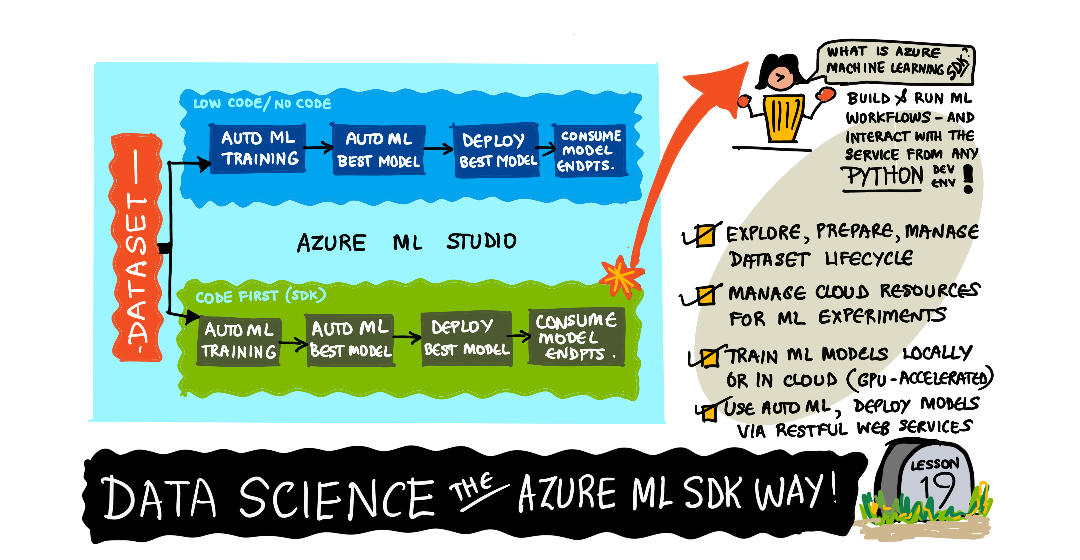
Cloud ML services range from do-it-yourself to done-for-you:
| Level | What you get | Example use |
|---|---|---|
| Compute | Rented machines/GPUs | Train your own model |
| ML platforms | Managed training + deployment | End-to-end projects |
| AutoML | Automated model building | Fast baselines |
| Pre-trained AI APIs | Ready models (vision, speech, language) | Add AI without training |
Key idea: You don't always have to train a model. For common needs — reading text, transcribing speech, detecting objects — a pre-trained API gives you AI in a single call, no data or training required.
Explain like I'm new: Picture making dinner. Raw compute is buying ingredients and cooking from scratch — total control, most effort. A pre-trained API is ordering a finished dish — fast and reliable, but you take it as it comes. AutoML and ML platforms sit in between, like a meal kit that does the hard prep for you.
Reading the table from top to bottom, you're trading effort for control. At the compute level you manage everything — the machine, the code, the training — and get complete freedom in return. At the pre-trained API level you manage almost nothing — you send data and get an answer — but you accept whatever the provider's model gives you. ML platforms and AutoML land in the useful middle, handling the fiddly infrastructure while still letting you shape the model. The skill isn't knowing every service by name; it's recognizing which rung of this ladder your particular problem actually needs.
2. Build vs. Use
- Build your own when your problem is unique and you have good data.
- Use a pre-trained service when your need is common and speed matters.
A helpful way to decide is to ask: "Has someone almost certainly solved this exact problem already?" Reading text from images, transcribing speech, translating languages, detecting common objects — these are solved problems that thousands of companies need, so providers have built excellent pre-trained models you can rent by the call. But "which of our specific products will this specific customer buy next?" is unique to your business; no vendor has your data or your catalog, so that's a build-your-own job. Common need plus speed points to a ready-made service; unique need plus good data points to training your own.
Simple example: Need to detect the language of some text? A pre-trained language API answers instantly. Training your own language detector would take data, time, and expertise for a solved problem.
Real-world use case: An app lets users upload receipt photos. Reading text from an image (OCR) is a solved, common problem — so the team calls a pre-trained vision API and gets text back in seconds. But categorizing each purchase into their own custom budget buckets is unique to their app, so they train their own small model for that part. One project, both approaches, each used where it fits.
3. Deploying Models
Cloud platforms also help you deploy — turning a trained model into a live service (an API) that apps can call, with monitoring and scaling handled for you (this connects to MLOps, Module 37). A model sitting in a notebook helps no one; deployment is what turns it into something a real app or website can actually use, thousands of times a day.
Common mistake: Building a custom model for a problem the cloud already solves. Re-inventing speech-to-text or face detection burns weeks for a result a pre-trained API delivers in an afternoon — and usually does worse.
Data scientist tip: Start at the highest useful level. If a pre-trained API solves it, use it. Drop down to custom training only when the ready-made options genuinely can't meet your need — it saves enormous effort.
Key Takeaway: Cloud ML services span a spectrum from raw compute to managed ML platforms, AutoML, and pre-trained AI APIs (vision, speech, language) you can call without training. Build your own for unique problems with good data; use pre-trained services for common needs. Start at the highest useful level and only go lower when needed.
Further Learning
Adapted from Microsoft's Data Science for Beginners (MIT License). Sketchnote by Nitya Narasimhan.