"From hospitals to sports fields to climate research — data science is quietly at work almost everywhere. Here's where it shows up."
Learning Objectives
By the end of this module, you will be able to:
- Name real fields transformed by data science
- Connect course concepts to real impact
- See the responsibility that comes with it
1. Data Science Everywhere
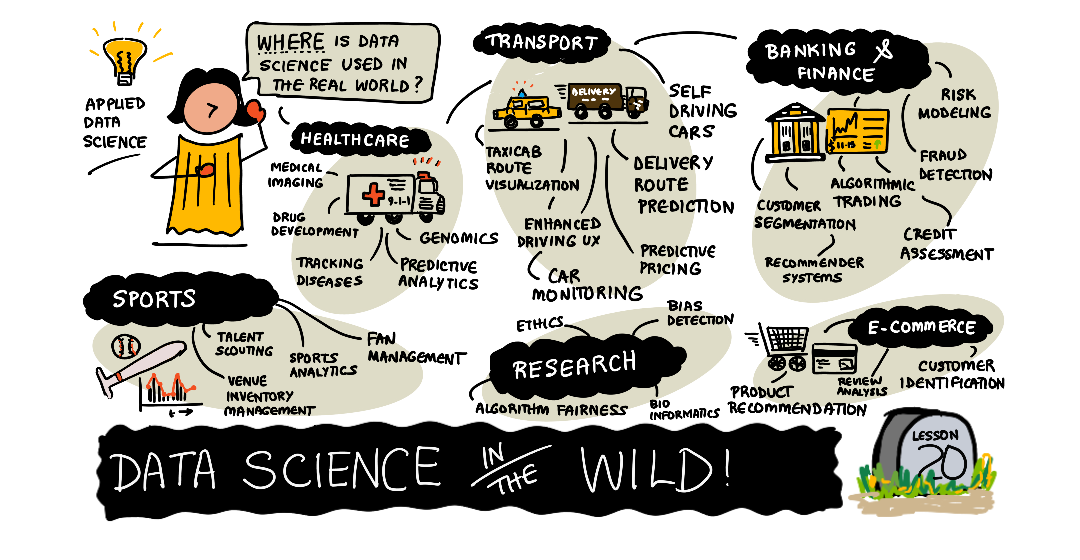
The techniques you've learned power real change across fields:
| Field | How data science helps |
|---|---|
| Healthcare | Predicting disease risk, speeding diagnoses |
| Finance | Fraud detection, risk scoring |
| Sports | Player performance and strategy |
| Climate & sustainability | Modeling emissions, tracking change |
| Humanities | Analyzing texts, art, and history at scale |
| Public health | Tracking outbreaks (like COVID data) |
Key idea: The same core skills — clean data, explore it, visualize it, model it, communicate it — apply whether you're studying cancer cells or football matches. Learn the fundamentals and the field is your choice.
Explain like I'm new: Data science is less like a single job and more like literacy — once you can read and write, you can apply it to law, medicine, or poetry. Once you can wrangle and interpret data, you can apply that to almost any field that produces numbers, which today is nearly all of them.
This portability is genuinely good news for a beginner. It means the effort you're putting into this course isn't tied to one narrow industry that might change or shrink. A data scientist who learns to clean, explore, and model data can move from sports analytics to healthcare to climate research without starting over — the tools travel with them; only the domain knowledge changes. Many data scientists deepen their impact precisely by pairing their general skills with real expertise in one field they love, becoming the rare person who understands both the data and what it actually means on the ground.
2. Concepts → Impact
- Visualization helps doctors and citizens grasp trends
- Statistics separates real effects from noise
- Machine learning predicts risk and demand
- Ethics keeps high-stakes decisions fair
What's striking is how these four show up together in almost every real project. On its own, a machine-learning prediction is just a guess; a statistic without a visual is easy to misread; a beautiful chart with no ethical check can quietly mislead. The impact comes from combining them — a prediction you can trust because the statistics were sound, explained through a visual people understand, guarded by ethical review so nobody is treated unfairly. This is why the course covered them all: they're not separate hobbies but the interlocking parts of one craft.
Simple example: During a public-health crisis, data scientists clean case counts, chart the curve, model the spread, and communicate clearly to guide decisions — every stage of this course, applied to something that matters.
Real-world use case: A city wants to reduce traffic accidents. Analysts clean years of collision records (Prepare), map hotspots (Visualize), test whether a junction is really riskier or just busier (Statistics), and predict where the next cluster may form (ML). They then present three clear recommendations to the transport board (Communicate). Every module in this course shows up in a single, tangible outcome: safer streets.
3. With Impact Comes Responsibility
Real-world data science affects real people, so ethics (Module 3) isn't optional. The bigger the impact, the more fairness, privacy, and human review matter. A model that recommends a movie can be a bit wrong with little harm; a model that flags a loan, a diagnosis, or a criminal risk score can change a life. That difference in stakes should change how carefully you build and check it.
Common mistake: Assuming that because a model is "just math," its results are neutral. Models learn from human data, so they can quietly inherit human bias. In high-stakes fields, someone must always check who the model might be unfair to.
Data scientist tip: Pick a field you care about and find its public datasets. Working on data you find meaningful keeps you motivated — and domain passion is what turns a competent analyst into a great data scientist.
Key Takeaway: Data science drives real impact across healthcare, finance, sports, climate, the humanities, and public health — all using the same core skills you've learned: clean, explore, visualize, model, communicate. The greater the real-world impact, the more ethics and responsibility matter. Choose a field you care about and dig into its data.
Further Learning
Adapted from Microsoft's Data Science for Beginners (MIT License). Sketchnote by Nitya Narasimhan.