"When data gets big and models get hungry, the cloud gives you as much computing power as you need — rented by the minute."
Learning Objectives
By the end of this module, you will be able to:
- Explain what "the cloud" means for data science
- See why data scientists use it
- Recognize the main benefits and trade-offs
1. What Is the Cloud?
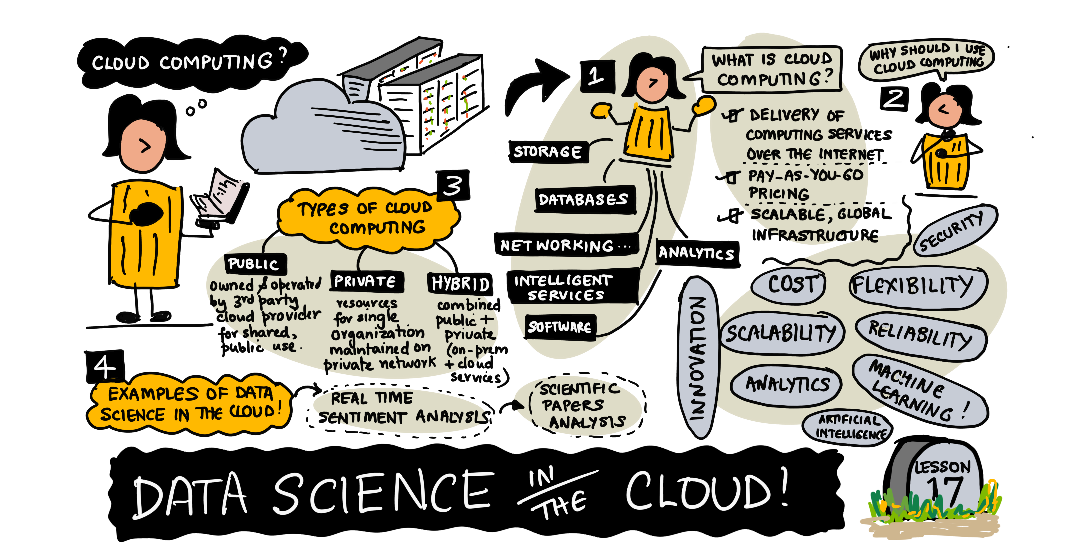
The cloud is simply someone else's powerful computers, available over the internet. Instead of buying expensive hardware, you rent exactly what you need, when you need it.
Key idea: The cloud removes the hardware ceiling. A laptop can't train a model on a billion rows — but you can rent a cluster in the cloud for an hour, run the job, and switch it off. You pay for what you use.
Explain like I'm new: Think of electricity. You don't build a power plant in your basement — you plug into the grid and pay for the kilowatt-hours you use. The cloud is a grid for computing: you plug in, use the machines you need, and pay only for the time they're switched on. The big providers here are Amazon (AWS), Microsoft (Azure), and Google (GCP).
The old way of doing serious data work was to buy a powerful server, wait weeks for it to arrive, set it up, and then own it forever — even during the months you barely used it. If your needs grew, you bought another. If they shrank, you were stuck with expensive hardware gathering dust. The cloud flips this completely: instead of owning computers you rent them by the hour, spinning up ten machines for a big job this afternoon and zero tonight. This shift from buying to renting is the single biggest reason data science scaled from a few big institutions to almost anyone with a laptop and an account.
2. Why Data Scientists Use It
- Scale — handle datasets far bigger than one computer
- Power — access GPUs for heavy machine learning
- Storage — keep huge datasets safely
- Collaboration — teams share data and notebooks
- Managed tools — ready-made data and ML services
Of these, scale and power are what beginners notice first — suddenly a dataset too big for your laptop is no problem. But collaboration and managed tools are what teams come to love most. When your data and notebooks live in the cloud, a colleague across the world opens the exact same environment you're working in, with no "it works on my machine" headaches. And managed services mean you don't have to install and maintain a database or a machine-learning framework yourself — the provider keeps it running, patched, and ready. That frees you to spend your time on the actual problem instead of on plumbing.
Try this: Most major cloud providers offer a free tier with a small allowance of compute and storage. Sign up for one, launch a tiny virtual machine, run a short script, and — importantly — shut it down again. Doing this once removes the mystery: you'll see the cloud is just a computer you reach over the internet.
Real-world use case: A small team needs to train an image model on 5 million photos. On their laptops it would take weeks — if it ran at all. In the cloud they rent eight GPU machines for four hours, finish the training overnight, and shut everything down. They paid for four hours of horsepower instead of buying hardware they'd use once.
3. Benefits & Trade-offs
| Benefit | Trade-off to watch |
|---|---|
| Pay only for what you use | Costs add up if left running |
| Massive scale on demand | Requires internet & accounts |
| Managed services save setup | Some lock-in to a provider |
The cloud is powerful, but it is not free and not automatic. The same flexibility that lets you scale up instantly also lets a mistake scale up instantly — which is why cost awareness is a genuine data-science skill, not just an IT concern.
Common mistake: Assuming "the cloud" means your data is automatically safe and private. You still control who can access it and how it's stored. Sensitive data in the cloud needs the same care you'd give it anywhere (Module 3 on ethics still applies).
Data scientist tip: Always shut down cloud resources when you're done. A forgotten running cluster is the classic way beginners rack up a surprise bill. "Turn it off" is a habit worth building early.
Key Takeaway: The cloud is rented computing power over the internet, letting data scientists scale beyond one machine — big data, GPUs, shared storage, and managed tools, paid by usage. The main trade-offs are ongoing cost (shut resources down!), internet dependence, and some provider lock-in.
Further Learning
- Data science in the cloud — Microsoft Learn Data Science
- Azure Machine Learning overview — Microsoft
Adapted from Microsoft's Data Science for Beginners (MIT License). Sketchnote by Nitya Narasimhan.