"Not all data fits neatly into tables. NoSQL databases trade rigid structure for flexibility and scale."
Learning Objectives
By the end of this module, you will be able to:
- Explain what non-relational (NoSQL) data is
- Compare it with relational databases
- Recognize common NoSQL types
- Know when to choose each
1. Beyond Tables
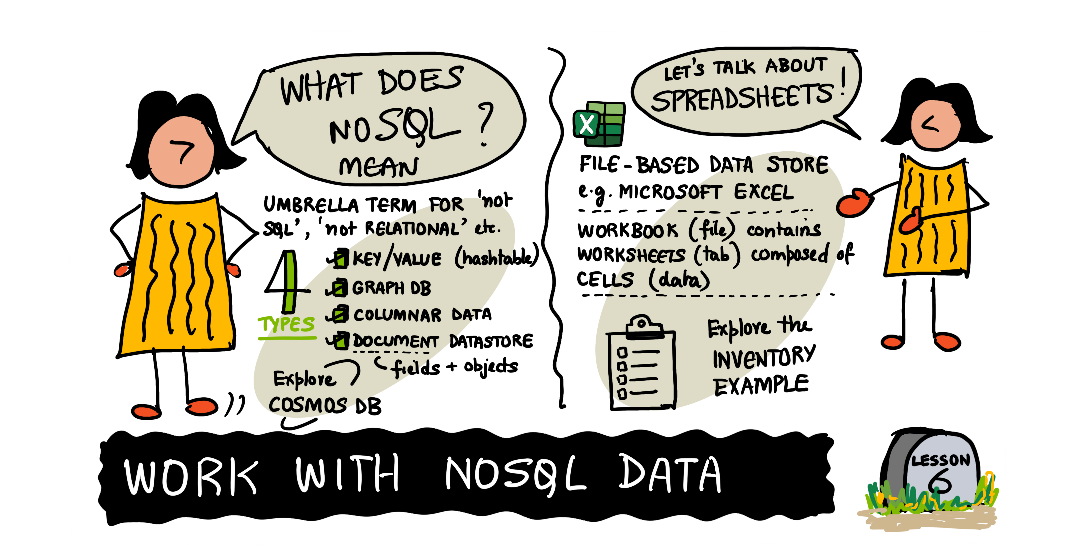
NoSQL ("not only SQL") databases store data without rigid tables. They're built for flexible, fast-changing, or huge amounts of data — like social posts, product catalogs, or sensor streams.
Key idea: Relational databases require you to define the structure up front. NoSQL lets the structure vary from record to record — great when your data is messy, evolving, or enormous.
Explain like I'm new: A relational table is like an official government form — every box is fixed, and everyone fills in the same boxes. A NoSQL store is more like a stack of sticky notes: each note can hold whatever it needs, and no two have to match. That freedom is the whole point.
2. Relational vs. NoSQL
| Relational (SQL) | NoSQL | |
|---|---|---|
| Structure | Fixed tables, defined first | Flexible, varies per record |
| Best for | Connected, consistent data | Large, changing, varied data |
| Example | Banking, orders | Social feeds, IoT, catalogs |
The trade-off underneath this table is structure versus flexibility. Relational databases give you guarantees — every row has the same columns, relationships stay consistent — but you must plan the shape in advance and changing it later is work. NoSQL gives you freedom and easy scaling across many machines, but you take on more responsibility for keeping the data sensible, because the database won't enforce a shape for you.
Scale is the other big reason NoSQL exists. When data grows past what one powerful machine can hold, NoSQL systems are built to spread it across many ordinary machines working together — a huge advantage for the internet-scale firehoses of posts, clicks, and sensor readings that modern apps generate every second.
3. Common NoSQL Types
- Document — flexible records, often JSON (e.g., MongoDB)
- Key-value — simple lookups by a key (e.g., Redis)
- Column — huge tables spread across machines
- Graph — data about connections (e.g., social networks)
Simple example: A shopping site might store each product as a flexible document — some products have "size," others "battery life," others "page count." No single fixed table could fit them all comfortably.
Each type suits a different job. Key-value stores are lightning-fast for simple "give me the value for this key" lookups, like a shopping cart. Graph databases shine when the connections themselves are the data — "friends of my friends who like hiking" is a natural graph question that would be painful in tables.
Concept: The most popular NoSQL type is the document store. A document is basically a flexible bundle of fields (often written as JSON) that can differ from one record to the next. Instead of forcing every product into identical columns, each product carries only the fields it actually needs — which is why document stores feel so natural for catalogs and content.
Real-world use case: A social network stores who-follows-whom in a graph database. Asking "suggest people two hops away in my network" is a quick graph traversal, whereas the same question across relational tables would need many slow, tangled joins.
4. Choosing Between Them
It's not "better vs. worse" — it's fit. Choose relational for structured, consistent, connected data; choose NoSQL for flexibility, massive scale, or rapidly changing shapes. Many real systems use both.
A typical large app might keep payments and accounts in a relational database (where consistency is sacred) while storing activity feeds and cached data in NoSQL (where speed and scale matter more). Mixing tools to fit each job is completely normal and often the sign of a thoughtful design.
Common mistake: Assuming "NoSQL" means "no rules" or "always faster." NoSQL simply moves the responsibility for structure from the database onto you. Skip that thinking and a flexible store quickly turns into a messy junk drawer where no two records agree — flexibility is a tool, not a free pass to ignore data design.
Data scientist tip: Don't get religious about SQL vs. NoSQL. Ask what the data and questions need. The right tool is the one that makes your actual problem easier.
Try this: For three things you use daily — a bank app, a photo feed, a maps app — guess whether each leans relational or NoSQL, and why. Matching data shape to storage type is a decision engineers make constantly.
Key Takeaway: NoSQL databases store data without rigid tables, trading fixed structure for flexibility and scale — ideal for large, varied, or fast-changing data. Types include document, key-value, column, and graph. Relational suits structured, connected data; NoSQL suits flexibility and scale; many systems use both.
Further Learning
Adapted from Microsoft's Data Science for Beginners (MIT License). Sketchnote by Nitya Narasimhan.