"Data science isn't a straight line — it's a cycle. You loop through stages, learning and refining as you go."
Learning Objectives
By the end of this module, you will be able to:
- Name the main stages of a data science project
- Understand why it's a loop, not a line
- See where each earlier module fits
1. The Cycle
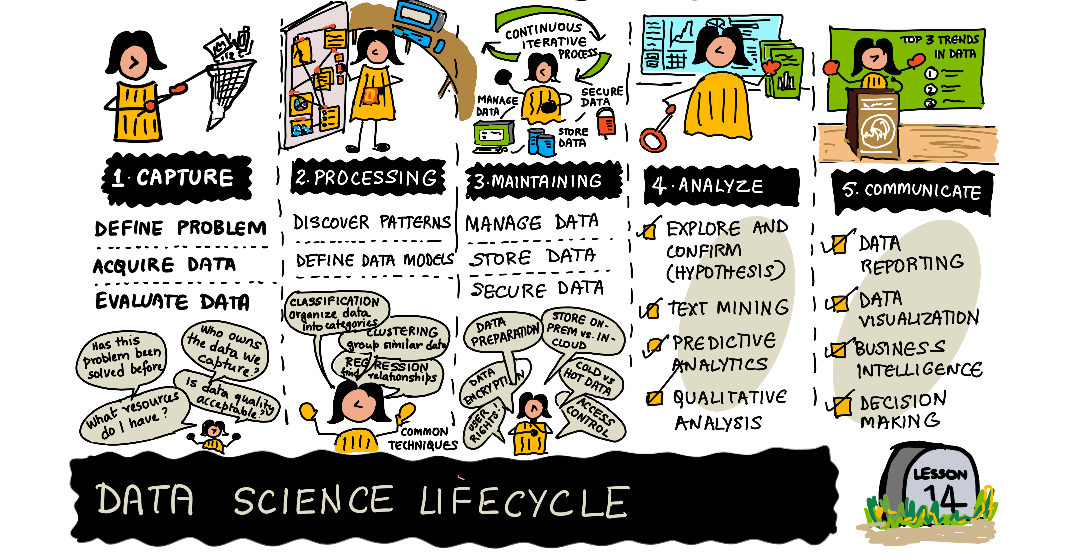
Most projects move through these stages:
- Ask — define a clear question or goal
- Acquire — gather the data you need
- Prepare — clean and shape it (Modules 10–11)
- Explore & analyze — find patterns (Module 19)
- Model — build predictions if needed (Modules 25+)
- Communicate — share the findings (Module 20)
Key idea: These stages loop. What you learn while exploring often sends you back to gather more data or sharpen the question. Data science is iterative — expect to go around more than once.
Explain like I'm new: Think of cooking a new recipe. You taste as you go (explore), realize it needs more salt (a new question), add it (more data), and taste again. You don't cook in one perfect straight shot — you loop through small adjustments until it's right. A data project works the same way.
It helps to picture the six stages arranged in a circle rather than a row. Ask sets the goal. Acquire brings in the raw ingredients. Prepare cleans and shapes them. Explore & analyze is where you actually get to know the data and test ideas. Model builds a prediction if the question needs one — plenty of good projects stop before this stage. And Communicate delivers the result to the people who will act on it. The arrow from Communicate doesn't end the story; it usually points right back to a sharper Ask for the next round.
2. Why a Loop?
Real insight rarely appears on the first pass. You explore, discover the question was slightly wrong, adjust, get better data, and try again. Each loop gets you closer. Beginners often expect a project to run cleanly from start to finish, so the loops feel like failure — but every loop is you learning something the data just taught you. Experienced data scientists plan for several rounds.
There's a second reason it must loop: the stages are not truly separate. What you learn while cleaning changes what you want to explore; what you find while exploring changes what you should have asked. A straight-line "waterfall" project pretends you can know everything up front, and it almost always ends with a polished answer to the wrong question. Treating the process as a loop bakes in room to be wrong early — which, for anything genuinely worth investigating, you usually are.
Simple example: You set out to predict store sales. While preparing data, you notice holidays skew everything — so you loop back, add a "holiday" flag, and your analysis improves. The detour was the progress.
Real-world use case: A team is asked, "Why are customers leaving?" Their first data pull only has account age. Exploration hints that support wait times matter, but that data lives in another system — so they loop back to Acquire, pull the support logs, and re-run the analysis. The second loop reveals the real driver. The first loop wasn't wasted; it told them where to look.
3. It Ties the Course Together
Everything you've learned maps onto the cycle: defining data and ethics (Ask/Acquire), cleaning (Prepare), statistics and visualization (Explore), machine learning (Model), and storytelling (Communicate). Seeing the whole loop at once is what turns a bag of separate skills into a repeatable process — the thing that actually makes someone a data scientist rather than a collector of techniques.
Common mistake: Rushing past Ask straight into building charts and models because that part feels productive. Without a sharp question, you generate a lot of impressive-looking output that nobody can act on.
Data scientist tip: Spend real time on the Ask stage. A sharp, answerable question saves you from beautifully analyzing the wrong thing. The most common project failure is solving a question nobody needed answered.
Key Takeaway: The data science lifecycle loops through Ask → Acquire → Prepare → Explore/Analyze → Model → Communicate. It's iterative, not linear — discoveries send you back to refine the question or gather more data. Every skill in this course maps onto a stage, and a sharp initial question is the highest-leverage step.
Further Learning
Adapted from Microsoft's Data Science for Beginners (MIT License). Sketchnote by Nitya Narasimhan.