"Just because we can collect and use data doesn't mean we should. Ethics is asking the harder question: is this fair and right?"
Learning Objectives
By the end of this module, you will be able to:
- Explain why data ethics matters
- Recognize consent, privacy, and ownership issues
- Spot bias and fairness problems
- Apply responsible-use habits
1. Why Ethics Comes First
Data is about people. Decisions made from data — who gets a loan, a job interview, or medical care — affect real lives. Ethics keeps those decisions fair, honest, and respectful.
It helps to remember that behind every row in a spreadsheet is a real person: a patient, a shopper, a job applicant. When you sort, filter, or score that data, you are quietly shaping their experience of the world. Ethics is simply keeping that person in mind at every step, rather than treating them as an anonymous data point.
Key idea: An analysis can be technically perfect and still be harmful — if the data was collected without consent, invades privacy, or bakes in unfair bias. Correct math isn't the same as ethical use.
Explain like I'm new: Think of data like a photograph of someone. Even a perfectly focused, technically flawless photo can be wrong to take or share if the person never agreed to it. Ethics is about permission and respect, not just image quality.
2. The Core Concerns
| Concern | The question to ask |
|---|---|
| Consent | Did people agree to their data being used this way? |
| Privacy | Is personal information protected and anonymized? |
| Ownership | Who owns this data, and who can access it? |
| Bias | Does the data over- or under-represent some groups? |
| Fairness | Are outcomes equitable across different people? |
| Transparency | Can we explain how a decision was reached? |
These six aren't separate boxes to tick — they overlap. Poor consent often leads to privacy harm; hidden bias produces unfair outcomes; and without transparency no one can even tell when something went wrong. Strong ethics usually means all six pulling in the same direction.
3. Bias & Fairness
Bias creeps in when data reflects past unfairness. A hiring model trained on a company's historical hires can learn to prefer the same kind of people — automating old bias at scale.
The danger is scale and speed. A single biased human interviewer affects a handful of candidates; a biased model can screen thousands of résumés a day, quietly repeating the same unfair pattern to everyone, while looking objective because "the computer decided."
Real-world use case: A photo app once labeled images poorly for some skin tones because its training photos underrepresented those groups. The math worked exactly as designed — the data was the problem. Fixing it meant collecting a more representative dataset, not tweaking the algorithm.
Common mistake: Assuming data is "neutral." Data records human choices, and human choices carry bias. Always ask who is in the data, who is missing, and whose behavior am I about to automate?
4. Responsible Habits
- Collect only what you need
- Anonymize personal details
- Document where data came from
- Check results across different groups
- Keep a human in the loop for high-stakes decisions
"Collect only what you need" is worth pausing on: every extra piece of personal data you gather is something you now have to protect and could accidentally leak. The safest data is the data you never collected. And "check results across groups" means slicing your outcomes — does the model work as well for young and old, for every region — rather than trusting one overall average.
Data scientist tip: Before publishing any result, run a quick "harm check": Who could this affect, and could it mislead or disadvantage anyone? Five minutes of reflection prevents real damage.
Try this: Take an everyday algorithm — a video recommender, say — and list who might be treated unfairly by it and who is missing from its data. This simple exercise trains the ethical instinct professionals rely on.
Key Takeaway: Data ethics ensures analyses are fair, honest, and respectful of people. The core concerns are consent, privacy, ownership, bias, fairness, and transparency. Data is never truly neutral — it carries human bias — so collect responsibly, anonymize, check across groups, and keep humans in the loop for decisions that affect lives.
Further Learning
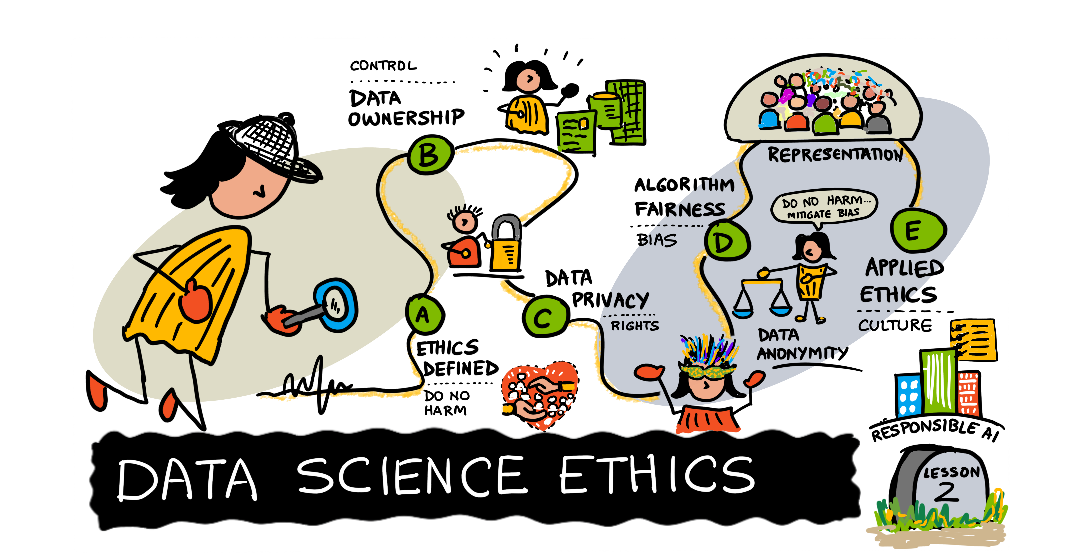
Adapted from Microsoft's Data Science for Beginners (MIT License). Sketchnote by Nitya Narasimhan.