"Every AI tool integration used to be custom-built. MCP is the universal plug — one standard so any AI app can connect to any tool or data source."
Level: Intermediate · Time: ~13 min · Prerequisites: Module 18
Learning Objectives
By the end of this module, you will be able to:
- Explain what the Model Context Protocol (MCP) is
- Understand the problem it solves
- See why a standard matters
- Recognize where MCP fits
1. The Problem: N×M Integrations
Before MCP, connecting an AI app to a tool (a database, GitHub, your files) meant writing custom glue code for every app-to-tool pair. Ten apps × ten tools = a hundred bespoke integrations. It didn't scale. Worse, each integration was a throwaway: the code you wrote to wire one assistant to GitHub couldn't be reused by a different assistant, and if GitHub's API changed, every app that touched it had to be patched separately. The industry was rebuilding the same connectors over and over.
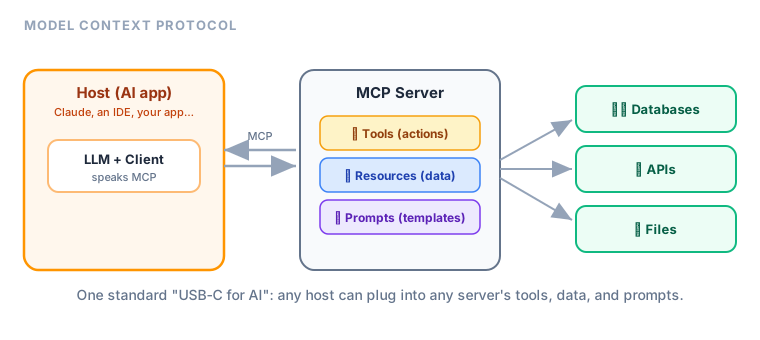
MCP (Model Context Protocol) is an open standard that fixes this: tools expose themselves through MCP once, and any MCP-aware app can use them.
Explain like I'm new: MCP is "USB-C for AI." Before USB-C, every device had its own charger. Now one port fits everything. MCP is that universal port between AI apps and the tools/data they need — build it once, plug in anywhere.
Concept: MCP was introduced by Anthropic in late 2024 and quickly adopted across the industry precisely because it's open — not tied to one company's model. That openness is what turns it into a shared ecosystem rather than one vendor's walled garden.
2. Why a Standard Matters
- Reusability: build an MCP server for your database once; every AI app can use it.
- Interoperability: swap the AI app without rewriting integrations.
- Ecosystem: a growing library of ready-made servers (files, GitHub, Slack, databases…).
Key idea: MCP turns the messy N×M integration problem into a clean N+M one. Tools implement MCP once; apps speak MCP once; everything connects. Standards are boring — and they're exactly what makes ecosystems explode.
3. Where MCP Fits
MCP sits between an AI application (the "host," like an assistant or IDE) and external capabilities (tools, data, prompts). The host's LLM can then discover and use whatever the connected servers offer — live data, actions, and reusable prompts — without custom code per integration.
Real-world use case: An AI coding assistant uses MCP servers to read your file system, query your database, and open GitHub issues — three separate servers, one protocol. Add a new server (say, Jira) and the assistant instantly gains that capability, no rebuild required.
4. MCP and the Bigger Picture
MCP complements everything you've learned: LLMs (the brain), tools/function-calling (Module 18), and agents (Module 19). It standardizes how the model reaches tools and data — making agentic systems far easier to build and extend. Think of the relationship this way: function calling (Module 18) defines that a model can request a tool; MCP defines a standard way to package and share those tools so they're not locked inside a single app. An agent still runs its reason–act loop, but now the tools it acts with can come from any MCP server you connect.
Common mistake: Confusing MCP with an LLM or a framework. MCP is a protocol (a shared language), not a model or a library. It defines how apps and tool-servers talk — like HTTP defines how browsers and web servers talk.
Hands-On: Try This
Try this: List three tools you'd want an AI assistant to reach (your calendar, your notes, a weather API). With MCP, each would be a small server you build or install once. Sketch which is "data" (resources) and which is "actions" (tools) — you're previewing the next module.
✅ Checkpoint
- What problem does MCP solve?
- What's the "USB-C for AI" analogy about?
- Is MCP a model, a framework, or a protocol?
Answers: 1) The explosion of custom app-to-tool integrations (N×M → N+M). 2) One universal connector instead of a custom one per pairing. 3) A protocol — a shared language between AI apps and tool servers.
Key Takeaway: MCP (Model Context Protocol) is an open standard — "USB-C for AI" — that lets any AI app connect to any tool or data source without custom glue per pair. Build a tool as an MCP server once, and every MCP-aware app can use it. It's a protocol, not a model or framework, and it makes agentic systems far easier to extend.
Further Learning
Adapted from Microsoft's MCP for Beginners (MIT License).