"Language is messy, ambiguous, and deeply human — which is exactly why teaching computers to handle it is one of AI's grand challenges."
Level: Beginner–Intermediate · Time: ~13 min · Prerequisites: Modules 3–5
Learning Objectives
By the end of this module, you will be able to:
- Explain what NLP is and why it's hard
- Understand how text becomes numbers
- Describe embeddings in plain terms
- Recognize common NLP tasks
1. Teaching Computers Language
Natural Language Processing (NLP) helps computers read, understand, and generate human language. It powers search, translation, voice assistants, and chatbots.
Language is hard because it's ambiguous ("I saw her duck" — the bird, or the dodge?), full of context and sarcasm, and endlessly varied. The same word shifts meaning with setting: "bank" by a river versus "bank" for your money. Rules alone can't capture it — which is why NLP leans on machine learning.
Explain like I'm new: A computer reading text is like you reading a language you don't speak — you see symbols, not meaning. NLP's job is to convert those symbols into something the math can work with, then find the patterns that carry meaning.
2. From Words to Numbers
Models only understand numbers, so step one is always converting text:
- Tokenization: split text into words or word-pieces
- Bag of words: count how often each word appears — a simple numeric fingerprint
- Embeddings: represent each word as a list of numbers that captures meaning
Key idea: Embeddings are the breakthrough. They place words in a "meaning space" so that similar words sit close together — "king" near "queen," far from "pizza." Math can then reason about meaning: king − man + woman ≈ queen.
Explain like I'm new: Picture a giant map where every word is a dot. Words with similar meanings live in the same neighborhood: "happy," "glad," and "cheerful" cluster together, while "sad" sits across town. An embedding is just each word's address on that map — and once meaning becomes coordinates, the computer can measure how "close" two ideas are.
Concept: Nobody types in these coordinates by hand. Embeddings are learned automatically — a model reads billions of sentences and notices which words keep similar company ("coffee" and "tea" both get poured, served hot, and drunk in the morning), so it places them near each other. Linguists sum this up in a famous line: "you shall know a word by the company it keeps." Meaning, in other words, is inferred from context, not looked up in a dictionary.
3. Handling Sequences
Sentences are sequences — order matters ("dog bites man" ≠ "man bites dog"). Early NLP used Recurrent Neural Networks (RNNs) that read text word by word, keeping a running memory. Picture reading a long paragraph while only allowed to remember a one-line summary as you go — by the last sentence, details from the first have faded. That's exactly why RNNs struggled with long sentences: they'd "forget" the start. The fix — transformers — is the next module.
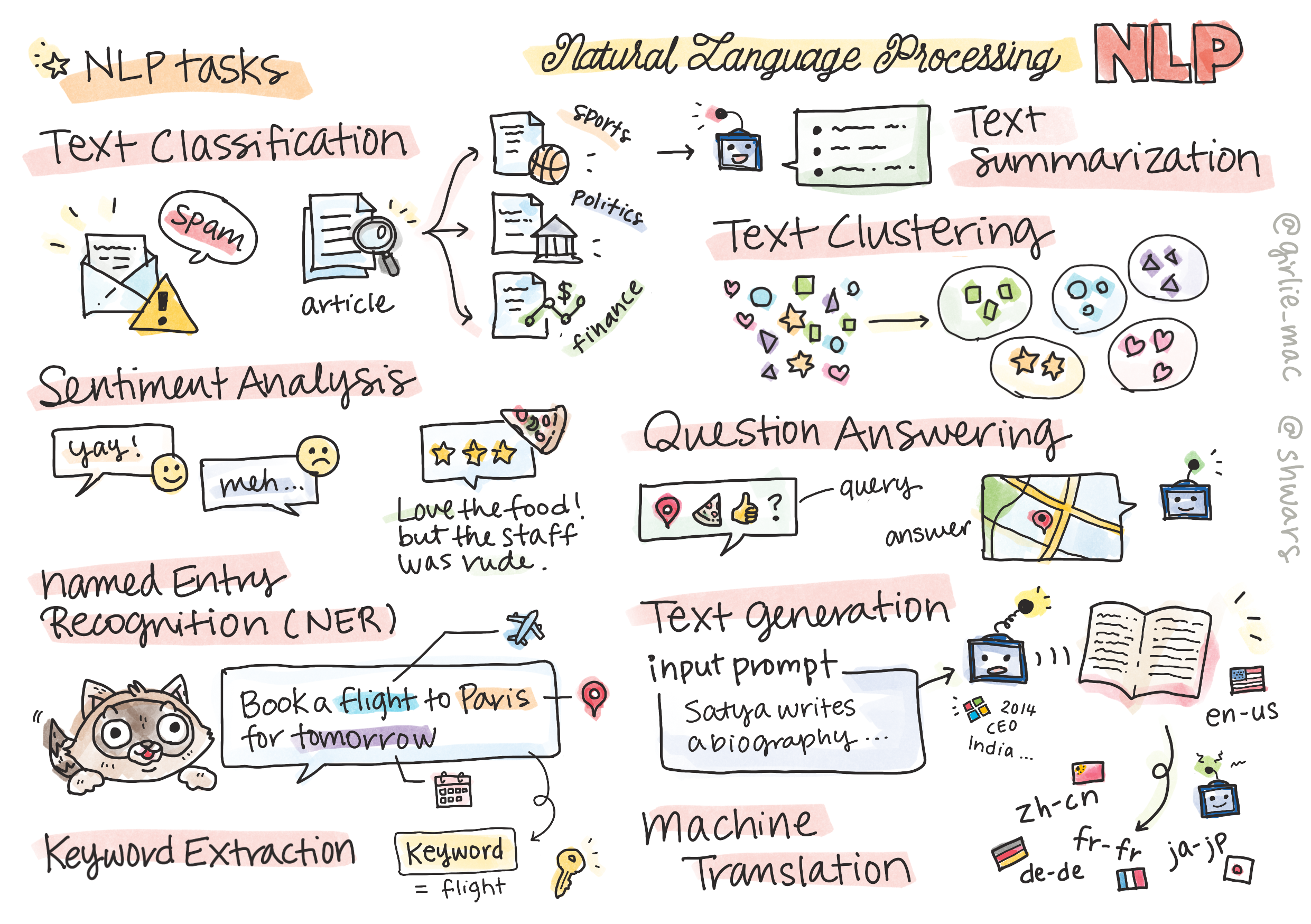
Real-world use case: Sentiment analysis scans thousands of product reviews and labels each positive or negative — turning a flood of comments into an instant mood summary. It's classification (Module 3) applied to text turned into numbers.
4. Common NLP Tasks
Once text is numbers, the same handful of techniques powers a wide range of everyday tasks:
| Task | Example |
|---|---|
| Sentiment analysis | Positive or negative review? |
| Translation | English → Spanish |
| Summarization | Shorten a long article |
| Named entity recognition | Find names, places, dates |
| Question answering / chat | Answer in plain language |
Real-world use case: A customer-support inbox often chains several of these at once — named entity recognition pulls out the order number and product, sentiment analysis flags an angry message as urgent, and summarization hands the agent a one-line gist before they even open it. Real NLP systems rarely do one task in isolation; they stack them into pipelines.
Hands-On: Try This
Try this: Think of a sentence whose meaning flips with word order ("only I love you" vs. "I love only you"). This is why NLP models must understand sequence, not just which words appear — a limitation early methods struggled with.
Common Mistakes
Common mistake: Assuming NLP models "understand" language like humans. They find statistical patterns — powerful, but they miss true meaning, sarcasm, and context. Always sanity-check important outputs.
✅ Checkpoint
- Why must text be turned into numbers?
- What do embeddings capture that word-counts don't?
- Why does word order matter in NLP?
Answers: 1) Models only work with numbers. 2) Meaning/similarity between words. 3) Order changes meaning ("dog bites man" ≠ "man bites dog").
Key Takeaway: NLP helps computers work with human language, which is hard due to ambiguity and context. Everything starts by turning text into numbers — via tokenization, bag-of-words, and meaning-rich embeddings. Order matters, so models must handle sequences (early RNNs, then transformers). NLP powers sentiment analysis, translation, summarization, and chat.
Further Learning
Adapted from Microsoft's AI for Beginners (MIT License). Sketchnote by Tomomi Imura.