"You went from 'what is Java?' to building agentic AI systems on Spring Boot. Here's the whole map — and where the road goes next."
Level: All levels · Time: ~10 min · Prerequisites: the journey so far
Learning Objectives
By the end of this module, you will be able to:
- See the full track at a glance
- Understand the six stages you completed
- Know what to build and learn next
- Plan your growth as a Spring AI developer
1. The Whole Journey
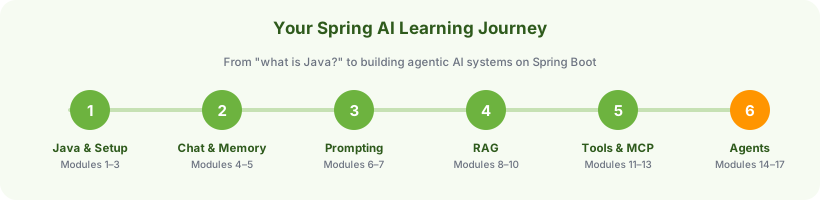
Take a moment to look back at how far this map stretches. You started not knowing what a class or a bean was, and you finish able to wire up memory, ground a model in your own documents, give it tools, and orchestrate multi-step agentic workflows — all on the Spring Boot foundation you already trust. Each stage below built directly on the one before it. That layering is deliberate: nothing here required you to abandon what you already knew — it kept adding one new capability at a time.
2. The Six Stages
| Stage | Modules | You learned to… |
|---|---|---|
| 1. Java & Setup | 1–3 | Understand Spring AI, Java/Spring basics, and set up your environment |
| 2. Chat & Memory | 4–5 | Build a chatbot that remembers, using tokens wisely |
| 3. Prompting | 6–7 | Get better answers with prompt patterns |
| 4. RAG | 8–10 | Let AI answer from your documents |
| 5. Tools & MCP | 11–13 | Let AI take real actions, locally and over MCP |
| 6. Agents | 14–16 | Orchestrate multi-step agentic workflows |
Key idea: You don't need to master everything before being useful. Chat + prompting + one of RAG/tools, plus a small project, is already enough to build something real at work or in a portfolio.
3. What to Build Next
The fastest way to cement everything is to build something small and finish it. Pick one idea below and take it end to end rather than starting five and completing none:
- Ship a small app — a "chat with my notes" RAG assistant is the perfect first project (chunk → embed →
QuestionAnswerAdvisor). - Add a tool — give your chatbot one real capability (a weather lookup, a database query).
- Try MCP — expose a tool on an MCP server and call it from a client.
- Combine patterns — build a small routing or evaluator-optimizer workflow.
- Put it on GitHub with a clear README and an architecture diagram.
Try this: Before writing any code, sketch your app's data flow on paper: where does the user's question enter, which advisor or tool handles it, and where does the answer come from? Five minutes of drawing saves hours of refactoring.
Real-world use case: A Java developer finishes this track, adds a RAG "chat with our docs" feature to their team's existing Spring Boot app in a week, and demos it at standup. No Python rewrite, no ML degree — just Spring AI and the skills from these 17 modules.
4. How to Keep Growing
Learning doesn't stop at the last module — it shifts from following a track to steering your own. A few directions worth taking:
- Read the Spring AI docs — you now have the vocabulary to follow them.
- Explore other providers — swap OpenAI for Anthropic or a local model by changing config.
- Learn production concerns — persistent vector stores, observability, testing, cost.
- Explore this platform's other tracks — Gen AI, AI Agents, and Zero to AI Engineer all reinforce these ideas.
Common mistake: Staying in "tutorial mode" forever. You've done the learning — the growth now comes from building real things and iterating. One shipped project teaches more than ten more tutorials.
✅ Checkpoint
- Name the six stages of this track.
- What makes a great first project?
- What's the antidote to "tutorial mode"?
Answers: 1) Java & Setup, Chat & Memory, Prompting, RAG, Tools & MCP, Agents. 2) A small but complete app — e.g., a "chat with my notes" RAG assistant. 3) Building real projects and iterating, not consuming more tutorials.
Key Takeaway: The track runs through six stages — Java & Setup → Chat & Memory → Prompting → RAG → Tools & MCP → Agents. You needn't master all before being useful: chat, prompting, and one of RAG/tools plus a shipped project is employable. Grow by building real apps, exploring providers and production concerns, and escaping "tutorial mode" — your projects are your portfolio.
Further Learning
- Spring AI reference docs
- Spring AI examples & samples
- Source curriculum: Spring AI for Beginners
Part of "Spring AI for Beginners." Adapted from Microsoft's open Spring AI curriculum (MIT License).