"You now know the classic techniques. This is where they leave the notebook and quietly go to work — in banks, hospitals, classrooms, and farms around the world."
Learning Objectives
By the end of this module, you will be able to:
- Connect each technique you learned to real industry uses
- Understand that classical ML is still everywhere, not just deep learning
- Explain why models must be monitored and debugged after launch
- Apply Responsible AI thinking to real deployments
- See where your learning journey can go next
1. From the Classroom to the World
Congratulations — you've traveled through the whole landscape of classical machine learning: regression, classification, clustering, natural language processing, time series, and reinforcement learning. You might be wondering: what is all of this actually for?
Here's a truth that surprises people: while the headlines celebrate deep learning, the classical models you just learned run an enormous share of the real world. They're faster, cheaper, easier to explain, and often just as accurate for everyday problems. You almost certainly benefited from one today.
2. A Tour of Industries
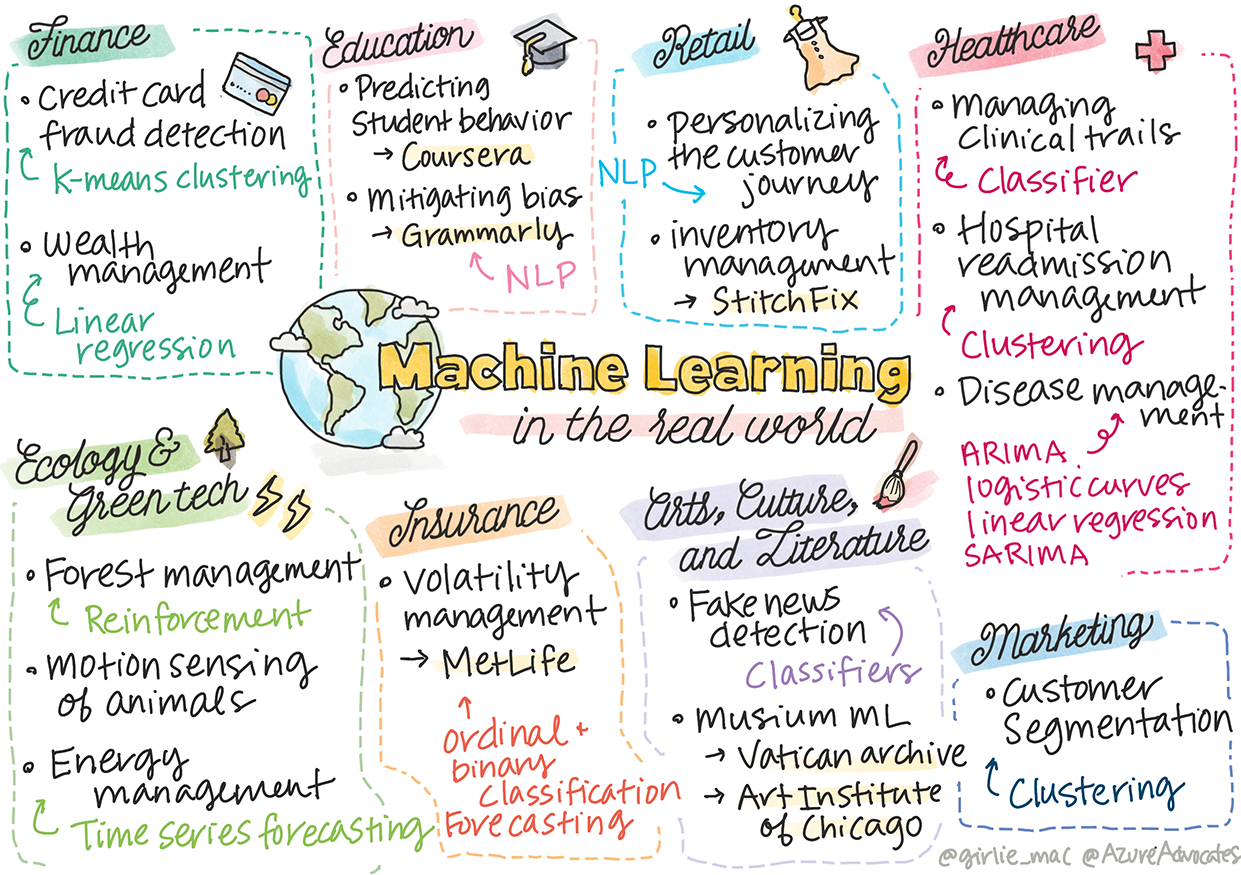
Every technique from this track has a real job somewhere. Here's a small tour:
| Industry | Technique | Real use |
|---|---|---|
| Finance | Clustering | Spotting credit-card fraud as an "outlier" transaction |
| Finance | Regression | Measuring how an investment fund performs vs. a benchmark |
| Healthcare | Classification | Predicting disease risk from patient features |
| Education | Regression | Linking course quality to student retention |
| Retail | Time series | Forecasting demand to stock the right amount |
| Marketing | Clustering | Segmenting customers to tailor offers |
| Writing tools | NLP | Catching errors and reducing biased suggestions |
Did You Know? That credit-card fraud alert you might get within seconds of a suspicious purchase? It often uses clustering (Module 8) — a normal transaction fits a familiar cluster, while a fraudulent one stands out as an oddball far from any group. The "sock drawer" algorithm is protecting your money.
Notice how the same handful of techniques reappear across wildly different fields. That's the quiet power of learning fundamentals: they transfer everywhere.
3. Models Aren't "Done" at Launch
A model is not a cake you bake once and forget. The real world changes — and a model trained on last year's data can quietly go stale. This is called drift.
- Shopping habits shift; a demand forecast drifts.
- Fraudsters invent new tricks; a fraud detector drifts.
- Language evolves; a sentiment model drifts.
So professional teams monitor their models after launch, watching for slipping accuracy, and retrain them on fresh data when needed. Debugging a live model — asking why it made a bad call — is now a core skill, supported by tools like Responsible AI dashboards that reveal where a model is weak or unfair.
Warning: The most dangerous model is one everyone assumes is still working. Silent drift can erode accuracy for months before anyone notices — often hurting some groups more than others. "Deploy and monitor," never "deploy and forget."
4. Responsible AI, For Real
Remember Module 2? This is where those principles stop being theory. In production, with real people affected, they become daily practice:
- Fairness: does the model treat all groups equitably? (Test it, don't assume it.)
- Transparency: can you explain a decision to the person it affects?
- Accountability: who answers when it's wrong — and how does someone appeal?
- Privacy: is personal data protected at every step?
The most technically impressive model is a failure if it's unfair, unexplainable, or unsafe. Responsible AI is what separates a model that's clever from one that's trustworthy.
5. Your Journey From Here
Look how far you've come. You can now explain what machine learning is, build models that predict numbers and categories, discover hidden groups, work with language and time, and even train an agent by reward — and you can do it all responsibly.
Where next? You've built the exact foundation that makes the advanced world approachable:
- Deep learning & neural networks — the engine behind image and speech AI
- Large language models — the technology powering modern chatbots
- Specialized paths — computer vision, MLOps, AI engineering, and more
Every one of those builds directly on the fundamentals you now hold. The skyscraper always needs the foundation first — and you've laid it.
Try This! Revisit the note you started in Module 1, spotting ML in the wild. Now, for each example, name which technique is likely behind it — regression, classification, clustering, NLP, time series, or reinforcement learning. What felt like magic in Module 1 should now read like a set of familiar tools. That shift — from mystery to understanding — is exactly what this track set out to give you.
Key Takeaway: Classical machine learning quietly powers finance, healthcare, education, retail, and more — the same few techniques, reused everywhere. Models must be monitored for drift and debugged after launch, and Responsible AI turns from principle into daily practice when real people are affected. You've built a complete foundation — and everything advanced in AI grows from exactly here.
This module is adapted from Microsoft's open-source ML-For-Beginners curriculum (MIT License). Real-world sketchnote by Tomomi Imura (CC BY-SA 4.0).