"A machine learning model is not programmed with answers — it is shown examples until it works out the answers for itself."
Learning Objectives
By the end of this module, you will be able to:
- Explain what machine learning is in plain, everyday language
- Tell the difference between AI, machine learning, deep learning, and data science
- Describe how machine learning differs from traditional "rules-based" programming
- Recognize machine learning already at work in your daily life
- Understand what this track will (and will not) teach you
1. The Big Idea: Learning From Examples
Imagine teaching a small child what a cat is. You don't hand them a rulebook that says "a cat has four legs, pointy ears, whiskers, and fur." You simply point at cats — on the street, in books, in videos — and say "cat." After enough examples, something clicks. The child can suddenly spot a cat they have never seen before, even a fluffy one, a hairless one, or a cartoon one.
That "click" is the heart of machine learning.
Machine learning (ML) is a way of getting computers to learn from examples instead of following step-by-step instructions we write by hand. We show the computer lots of data, it finds the hidden patterns, and then it uses those patterns to make decisions about new data it has never seen.
Concept: Traditional software follows rules a human wrote. Machine learning writes its own rules by studying data. We supply the examples and the goal; the machine works out the pattern that connects them.
Think of your email spam filter. Nobody sat down and wrote "if the email contains the word lottery three times, mark it as spam." Instead, the filter was shown millions of emails already labeled "spam" or "not spam," and it learned — on its own — which patterns tend to signal junk. That is why it keeps getting better over time.
2. AI, Machine Learning, Deep Learning, and Data Science
These four terms get tossed around as if they mean the same thing. They don't. The easiest way to picture them is as nested boxes — one inside the other.
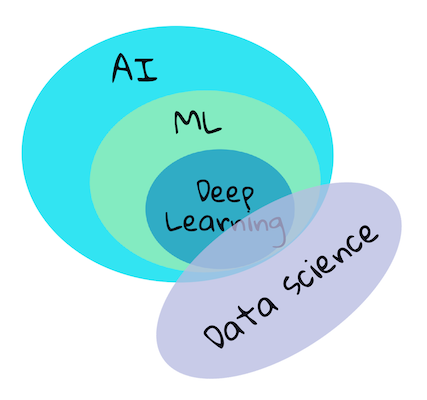
| Term | In one sentence | Everyday example |
|---|---|---|
| Artificial Intelligence (AI) | The broad goal of making machines behave "intelligently." | A chess program that plans moves |
| Machine Learning (ML) | A part of AI where machines learn patterns from data. | A spam filter that improves with use |
| Deep Learning | A part of ML that uses brain-inspired "neural networks." | Face recognition on your phone |
| Data Science | The wider craft of drawing insight from data (overlaps with all of the above). | Finding out why sales dropped last month |
The key relationship: deep learning is a type of machine learning, and machine learning is a type of AI. Data science is the practical discipline that surrounds them all — collecting, cleaning, and making sense of data.
Did You Know? This track focuses on "classical" machine learning — the powerful, time-tested techniques that came before today's deep-learning boom. They are simpler to understand, need far less data and computing power, and are still used everywhere in the real world. Master these, and deep learning will make far more sense later.
3. How Is This Different From "Normal" Programming?
This is the single most important idea to grasp, so let's slow down.
In traditional programming, a human writes explicit rules. The computer just follows them:
Rules + Data → Answers
In machine learning, we flip it around. We give the computer the data and the answers, and it figures out the rules:
Data + Answers → Rules (a "model")
Once the machine has those learned rules — bundled together into what we call a model — we can feed it brand-new data and it will predict the answer.
| Traditional Programming | Machine Learning | |
|---|---|---|
| Who writes the rules? | A human, by hand | The computer, by learning |
| Good for | Clear, fixed logic (tax calculations) | Fuzzy patterns (is this a cat?) |
| Gets better with more data? | No | Yes |
| Example | "If temperature > 38°C, show fever warning" | "Look at 10,000 patient records and predict illness" |
Concept: A model is the end product of machine learning — the learned pattern, saved and reusable. Training a model is like studying for an exam; using the model is like taking the exam with new questions.
Why bother learning patterns instead of writing rules? Because some problems have too many rules to ever write down. You could never hand-code every possible way a cat might look, or every sentence that counts as a positive movie review. But a machine can learn those patterns from examples in minutes.
4. A Whirlwind History of Machine Learning
Machine learning feels brand-new, but the ideas are surprisingly old. Here is the short version.
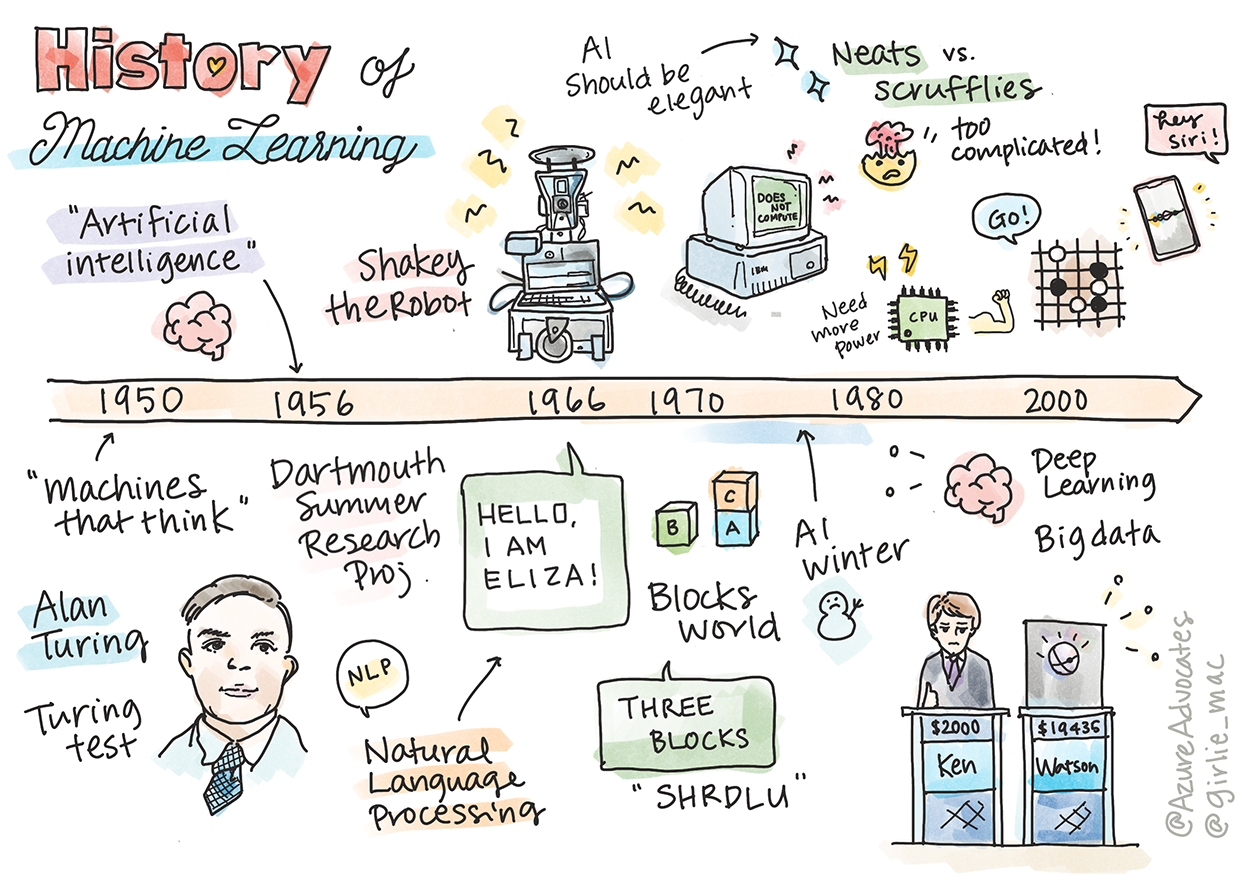
| Year | Milestone | Why it mattered |
|---|---|---|
| 1763 | Bayes' Theorem | The math of updating beliefs with evidence — still core to ML today |
| 1805 | Least Squares | A way to fit a line to data — you'll use it in the Regression module |
| 1950 | The Turing Test | Alan Turing asks: can a machine think? |
| 1956 | Dartmouth Workshop | The term "artificial intelligence" is officially born |
| 1956–1974 | The "Golden Years" | Huge optimism; early chatbots (Eliza) and robots (Shakey) appear |
| 1974–1980 | The "AI Winter" | Reality bites — too little data, too little computing power; funding dries up |
| 1980s | Expert Systems | Rule-based AI finds real business use |
| 1990s–2011 | The Data Explosion | The internet and smartphones flood the world with data, and ML comes roaring back |
| Today | ML Everywhere | From your phone's keyboard to medical diagnosis |
Fun Fact: In 1967, AI pioneer Marvin Minsky confidently predicted that the problem of creating artificial intelligence would be "substantially solved" within a generation. He was a little optimistic — but the "AI winter" that followed taught the field a lasting lesson: ML is only as good as the data and computing power behind it. That is exactly why it exploded once the internet arrived.
The pattern of history is clear: machine learning didn't take off because of one genius invention. It took off when we finally had enough data and enough computing power to let the old ideas shine.
5. Where You Already Meet Machine Learning
You almost certainly used machine learning today without noticing. It is quietly everywhere:
- On your phone: predictive text, photo face-grouping, voice assistants
- When you shop: "customers who bought this also bought…" recommendations
- When you watch or listen: Netflix and Spotify suggestions
- At the bank: fraud detection flagging a suspicious transaction in milliseconds
- In healthcare: predicting illness risk from medical history
- On the road: navigation apps predicting traffic and arrival times
Across finance, medicine, science, space exploration, and even the arts, machine learning is used to tackle problems with so many variables that no human could write the rules by hand.
Try This! For the next 24 hours, keep a note on your phone every time you suspect machine learning is at work — a recommendation, an autocomplete, a spam flag, a face unlock. You will be surprised how long the list gets. This habit of spotting ML in the wild will make every later module click faster.
6. What This Track Covers (and What It Doesn't)
To keep your first journey friendly and focused, we deliberately stick to classical machine learning using approachable, industry-standard tools (mainly a Python library called Scikit-learn, which you'll meet soon).
We will cover: the core ideas of ML, its history, fairness and responsible use, and hands-on techniques — regression, classification, clustering, natural language processing, time-series forecasting, and reinforcement learning — finishing with real-world applications.
We will not dive deep into: neural networks and deep learning, or the frontier of large AI systems. Those are exciting next steps — but a strong grasp of the fundamentals here is exactly what makes them understandable later. You're building the foundation the whole skyscraper stands on.
Key Takeaway: Machine learning is teaching computers to learn patterns from examples rather than following hand-written rules. It sits inside the bigger field of AI, it powers tools you already use daily, and it became world-changing only once we had enough data and computing power. In this track, you'll learn the classic, foundational techniques — the ones that make everything else in AI make sense.
This module is adapted from Microsoft's open-source ML-For-Beginners curriculum (MIT License). History sketchnote by Tomomi Imura (CC BY-SA 4.0).