
"You've built the foundation. Here's how to keep climbing — one small, confident step at a time."
Learning Objectives
By the end of this module, you will be able to:
- Follow a clear beginner → intermediate path
- Choose practice activities that build real skill
- Pick tools to explore next
- Know what "intermediate" looks like
1. The Path from Beginner to Intermediate
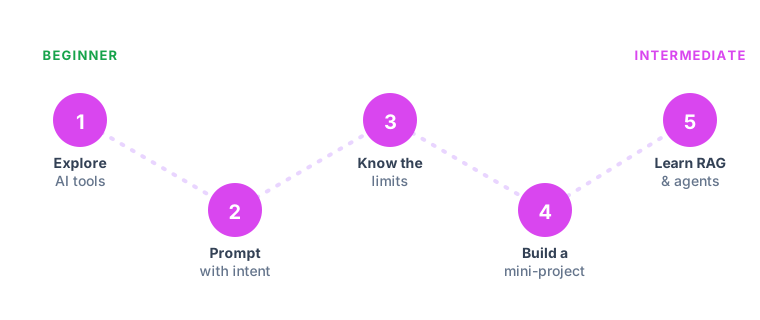
You don't level up by reading more — you level up by doing slightly harder things over time. Here's the journey:
Think of it like learning to cook. You don't start with a five-course dinner — you start with toast, then eggs, then simple pasta. Each dish is a little harder than the last, and by the time you attempt something ambitious, the basics are automatic. The five stages below work the same way: each builds gently on the one before.
2. Stage by Stage
| Step | What to do | You're ready to move on when… |
|---|---|---|
| 1. Explore AI tools | Use a chat assistant and an image tool daily for small tasks | Using AI feels natural, not scary |
| 2. Prompt with intent | Apply the four-part prompt (Module 3) every time | Your first prompt usually gets a good result |
| 3. Know the limits | Catch hallucinations; use AI safely (Module 6) | You instinctively verify important answers |
| 4. Build a mini-project | Finish one project from Module 7 end-to-end | You've shipped something you're a little proud of |
| 5. Learn RAG & agents | Explore giving AI your own data and tools | You can explain RAG to a friend |
Key idea: Progress comes from raising the difficulty just a little at a time. Master each step until it feels easy, then reach for the next. Comfort, then stretch — repeat.
3. Practice Activities
Small, repeatable habits beat occasional marathons:
- A prompt a day. Solve one real task with AI daily.
- Keep a prompt journal. Save prompts that worked (and why).
- Teach it back. Explain one concept from this track to someone else.
- Redo a task better. Take last week's prompt and improve it.
- Break something on purpose. Try to make the AI fail — you'll learn its edges.
That last habit deserves a word of encouragement. Deliberately pushing a tool until it stumbles teaches you where its limits are far faster than only using it politely. Every failure you provoke on purpose is one you'll recognize instantly when it matters.
Try this: Pick one of these habits and commit to it for a single week — just one. A tiny habit you actually keep beats an ambitious plan you abandon by Wednesday. Momentum, not intensity, is what carries beginners forward.
4. Tools to Explore
You don't need all of these — pick one per category and go deep:
| Category | Tools to try |
|---|---|
| Chat assistants | ChatGPT, Google Gemini, Claude, Microsoft Copilot |
| Image generation | DALL·E, Adobe Firefly, Midjourney |
| Learning platforms | Google Skills, Microsoft Learn, DeepLearning.AI |
| Building (later) | OpenAI / Google / Anthropic APIs, and no-code AI builders |
Common mistake: Tool-hopping — constantly chasing the newest app instead of getting genuinely good with one. Depth beats novelty. Master one assistant before you collect five.
5. What "Intermediate" Looks Like
You'll know you've crossed into intermediate territory when you can:
- Write prompts that reliably get strong results on the first or second try
- Explain how LLMs, RAG, and agents work — in plain words — to a friend
- Build a small tool (like a focused chatbot) that genuinely helps you
- Judge when not to use AI, and always keep a human in the loop for high-stakes work
Don't expect a fanfare when you cross this line — the shift is quiet. One day you'll realize you reached for AI without a second thought, got what you needed on the first try, and moved on. That easy fluency, more than any certificate, is what "intermediate" really feels like.
Real-world use case: An office manager who started this track barely trusting AI now drafts agendas, turns messy notes into clear action items, and has built a small chatbot answering new-hire questions from the company handbook. None of it is advanced on its own — but strung together, it saves her hours every week. That's the compounding payoff of steady, small practice.
From here, the natural next steps are deeper prompt techniques, hands-on RAG, connecting APIs, and — if you're curious — the intermediate Generative AI & LLM track on this site.
Key Takeaway: Grow by doing slightly harder things over time: explore tools, prompt with intent, respect the limits, build one real project, then learn RAG and agents. Practice in small daily habits, go deep on one tool instead of chasing every new app, and you'll reach intermediate before you know it.