"You've traveled the whole map of data science — from 'what is it?' to building and deploying models. Here's how to keep growing."
Learning Objectives
By the end of this module, you will be able to:
- See the full course journey at a glance
- Know what to practice next
- Plan your continued growth
1. The Journey You've Taken
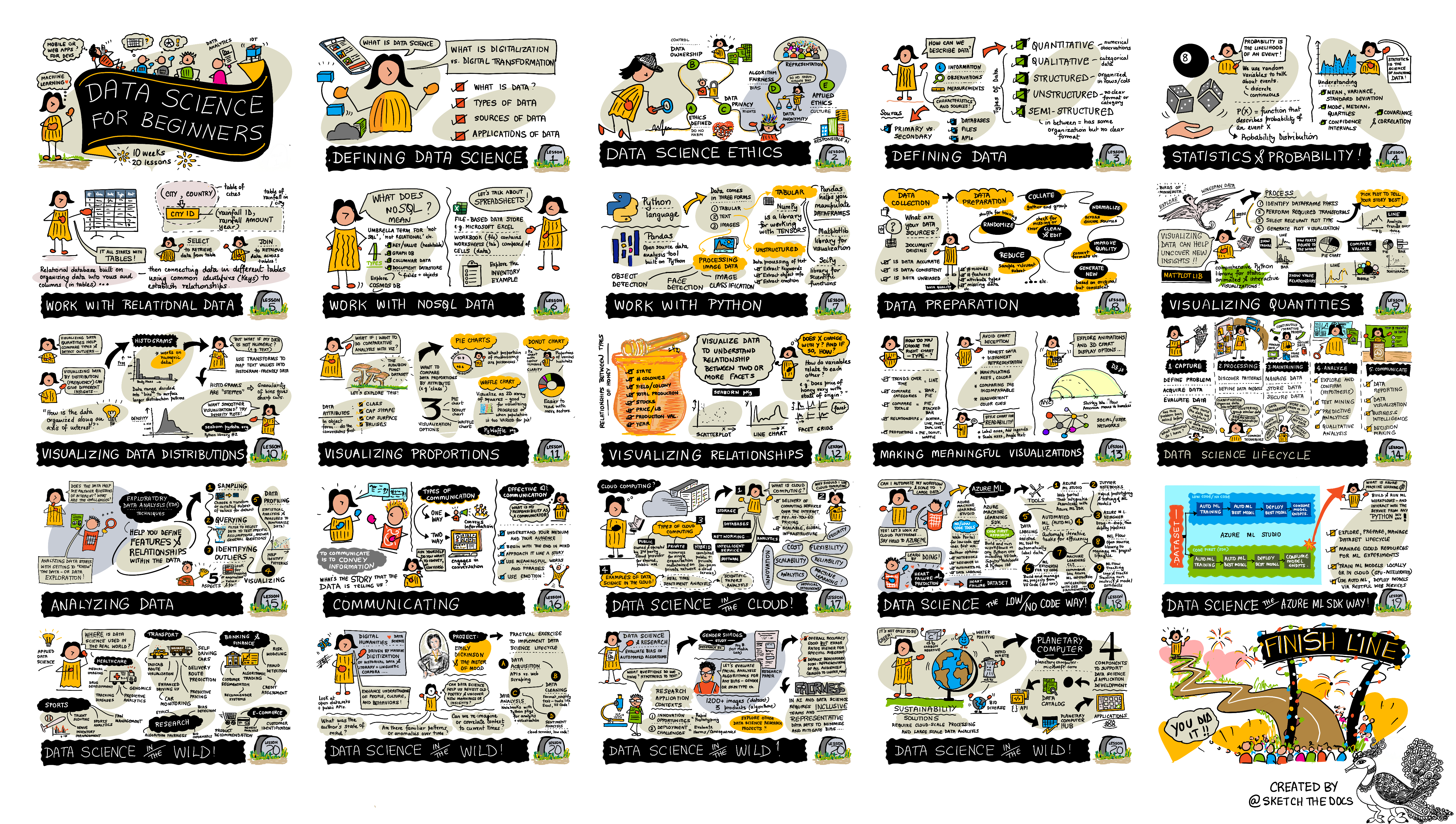
| Stage | Modules | What you learned |
|---|---|---|
| Foundations | 1–6 | What data science is, ethics, data, stats, probability |
| Working with data | 7–11 | Databases, Python, cleaning, quality |
| Visualization | 12–17 | Charts, honesty, choosing the right one |
| Lifecycle | 18–20 | Analyze and communicate |
| Cloud & real world | 21–24 | Scale, services, real impact |
| Machine learning | 25–31 | Features, regression, classification, clustering, evaluation |
| Advanced | 32–37 | Math, deep learning, NLP, vision, time series, MLOps |
| Tools & practice | 38–42 | Toolkit, mindset, projects, quiz, glossary |
Explain like I'm new: Look back at that table and give yourself credit. You started not knowing what "data science" meant, and you now understand the full arc — how raw data becomes insight, how models are built and judged, and how they're kept alive in production. That's a genuinely large map, and you've walked all of it.
2. What to Practice Next
- Finish a project from Module 40, end-to-end
- Enter a Kaggle competition — real problems, a supportive community
- Rebuild an analysis you liked, with your own dataset
- Share it — a notebook on GitHub is your portfolio
Key idea: You learn data science by doing it on data you care about. Pick a topic you love — sports, music, climate, games — find its data, and ask a real question. Passion sustains practice.
The reason "data you care about" matters so much is motivation. You will hit frustrating moments — a stubborn error, a chart that won't cooperate, a model that won't improve. When the topic genuinely interests you, curiosity pulls you through those walls. Analyzing your favorite team's season or your city's weather is far easier to finish than a generic dataset you feel nothing about.
Try this: This week, do one small thing rather than plan a big thing. Find a dataset about a topic you love, ask a single clear question, make one chart that answers it, and write two sentences about what you learned. That tiny finished loop — question to answer — is the whole job in miniature, and finishing it builds more confidence than a month of reading.
Real-world use case: Plenty of data scientists got their first job on the strength of a single passion project — a well-documented notebook analyzing something they loved, shared publicly. It shows an employer three things a résumé can't: that you can finish, that you can explain your thinking, and that you'll do the work even when nobody assigns it.
3. Where to Go Deeper
- Statistics & probability — the deeper you go, the sharper your judgment
- A specialization — ML engineering, analytics, or a domain (health, finance)
- Cloud & MLOps — for taking models to production
- On this platform — the ML for Beginners and Gen AI tracks pair well with these skills
Don't try to go deep everywhere at once. A useful sequence: cement the core loop with a couple of finished projects, then pick one direction that excites you and push into it. If you love the modeling, lean toward ML engineering; if you love the storytelling, lean toward analytics; if a field like healthcare or finance draws you, go deep there and let the domain guide which techniques you learn.
Above all, keep the learning active. Reading and watching feel productive, but skill grows from doing — from finishing messy, real projects and reflecting on what worked. Treat every module in this course as a door, not a destination: revisit the ones your projects lean on, and let genuine curiosity, rather than a checklist, decide where you go next.
Data scientist tip: Depth beats breadth early on. Rather than sampling ten tools, get genuinely good at the core loop — clean, explore, visualize, model, communicate — on real data. That loop is the job.
Key Takeaway: You've covered the full data science journey: foundations, working with data, visualization, lifecycle, cloud, machine learning, advanced topics, and tools. Grow by finishing real projects, entering Kaggle, and sharing notebooks as a portfolio — then pick one direction to go deep. Above all, keep practicing the core workflow with data you genuinely care about.
Further Learning
- Kaggle Learn — free micro-courses
- Data Science for Beginners — Microsoft
- Microsoft Learn — data science paths
Adapted from Microsoft's Data Science for Beginners (MIT License). Roadmap sketchnote by Nitya Narasimhan.