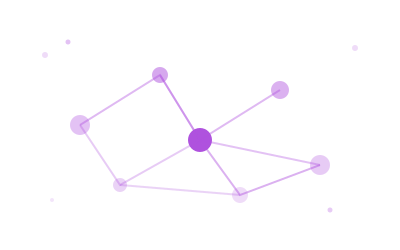
"Deep learning stacks simple units into 'neural networks' that can learn astonishingly complex patterns — the engine behind modern AI."
Learning Objectives
By the end of this module, you will be able to:
- Explain what a neural network is
- Understand why "deep" learning is powerful
- Know when it's worth using
1. Neural Networks, Simply
A neural network is layers of simple math units ("neurons") connected together. Each learns a small piece of the pattern; stacked in layers, they capture very complex relationships.
Key idea: "Deep" just means many layers. Early layers learn simple features (edges in an image), later layers combine them into complex ones (faces). Depth is what lets these models handle images, audio, and language.
Explain like I'm new: A single "neuron" is just a tiny function: it takes some numbers in, multiplies them by weights it has learned, adds them up, and passes the result on. One neuron is almost useless. But connect thousands across many layers, and each layer builds on the last — the way individual workers on an assembly line each do one small task, yet together they build a whole car.
Think of recognizing a friend's face. Your eye doesn't jump straight to "that's Sam." First it detects light and dark edges, then it assembles those into a nose, an eyebrow, a jawline, and only then into the whole face. A deep network learns the same hierarchy automatically: layer 1 finds edges, layer 2 finds shapes, layer 3 finds features, and the final layers say "this is a face — and it's Sam."
How does a network actually learn those weights? The same downhill idea from Module 32. It makes a guess, measures how wrong it was, and then nudges every weight a tiny bit in the direction that would have reduced the error — a process called backpropagation. Repeat that over millions of examples and the network gradually tunes itself. So deep learning is not magic: it's the familiar "guess, measure error, adjust, repeat" loop, just running across a very large, layered network.
Try this: Play with the free TensorFlow Playground in your browser. Add layers and watch the model learn to separate colored dots in real time. Seeing the boundary bend and adjust makes "layers learning features" click far faster than any diagram.
2. Why It's Powerful — and Costly
Deep learning shines on unstructured data — images, sound, text — where classic methods struggle. But it needs:
- Lots of data (often millions of examples)
- Lots of computing (GPUs, often in the cloud — Module 21)
- Care — it's harder to interpret ("black box")
Simple example: Face unlock on your phone is deep learning: layers detect edges, then features, then "this is you." Classic methods never matched it for images.
The "black box" problem is worth understanding. With a simple model like linear regression (Module 27), you can read the weights and say "price goes up $50 for each extra square meter." With a deep network of millions of connections, no human can trace why it decided a photo is a cat — it just is, statistically, very good at it. That opacity is fine for photo sorting but a real concern for high-stakes decisions like medical diagnoses or loan approvals.
Real-world use case: A radiology team uses a deep-learning model to flag possible tumors in scans. It's remarkably accurate — but because it can't explain its reasoning, a doctor always reviews every flag before acting. The model widens the net; the human makes the call.
3. When to Use It
Common mistake: Reaching for deep learning on a small, tidy table of numbers. For structured data, simpler models (Modules 27–28) are usually faster, cheaper, easier to explain, and just as accurate. Save deep learning for images, audio, and language.
A quick rule of thumb: if your data fits neatly in a spreadsheet and you have a few thousand rows, start with the classic models — they train in seconds and you can explain them to a stakeholder. If your data is raw pixels, audio waveforms, or free-form text, and you have lots of it, that's where deep learning earns its cost.
Data scientist tip: Master the classic models first. Deep learning builds on the same ideas (features, training, overfitting) — and understanding those makes neural networks far less mysterious when you get there.
Key Takeaway: Deep learning stacks simple units into many-layered neural networks that learn complex patterns — early layers catch simple features, later layers combine them. It excels at unstructured data (images, audio, text) but needs lots of data and compute and is harder to interpret (a "black box"). For tidy tables, prefer simpler models.
Further Learning
Part of the "Data Science and Data Scientist" course.