"Data science is the art of turning raw data into decisions — finding the story hidden inside the numbers."
Learning Objectives
By the end of this module, you will be able to:
- Explain what data science is in one sentence
- See why it matters in everyday life
- Recognize data science around you
- Tell data science apart from related fields
1. A Simple Definition
Data science is using data to understand things and make better decisions. A data scientist asks a question, gathers data, cleans and explores it, finds patterns, and shares what they learned so others can act on it.
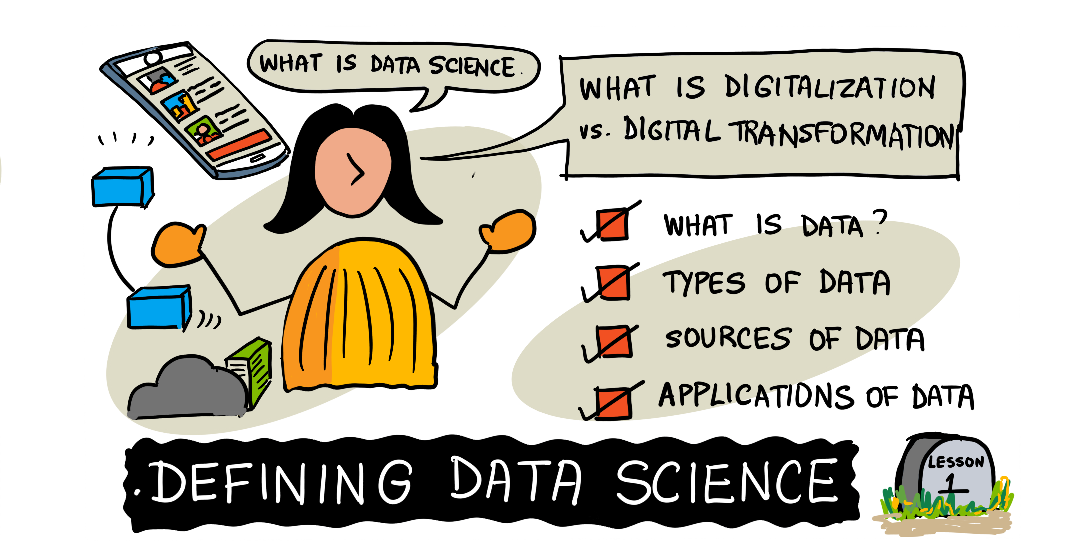
Think of each of those steps as a stage in a journey. You start with a question ("Are we losing customers?"), you gather the facts that could answer it, you clean those facts so they can be trusted, you explore them to spot what's really going on, and finally you tell the story clearly enough that someone can make a decision. Skip any stage and the journey breaks down — great data with a fuzzy question leads nowhere, and a brilliant insight nobody understands changes nothing.
Key idea: Data on its own is just numbers and text. Data science is the process that turns that raw data into insight — something useful you can act on.
Explain like I'm new: Imagine a shoebox full of every grocery receipt from the past year. The receipts are data. Sorting them, adding up what you spent on coffee versus vegetables, and realizing you could save $50 a month — that's data science. The receipts didn't change; your understanding did.
2. Why It Matters
Data science quietly shapes daily life:
- Streaming — Netflix and Spotify recommend what you'll like next
- Health — spotting disease risk earlier from patient data
- Sports — teams choose strategies from performance stats
- Shopping — "customers also bought…" and fair pricing
- Cities — routing traffic and planning transit
Most of these feel like magic, but each is the same simple loop running in the background: collect data, find a pattern, act on it. When your map app reroutes you around a jam, it is comparing live traffic data against past patterns and choosing the fastest path — data science working on your behalf, in real time.
Simple example: A coffee shop notices sales dip every rainy afternoon. That's data science in miniature: collect sales + weather data, spot the pattern, and act (a rainy-day promo).
Real-world use case: A small online store looked at which pages shoppers visited right before leaving without buying. The data pointed to one confusing checkout screen. They simplified it, and completed purchases rose noticeably — no new advertising, just listening to what the data was already saying.
3. How It Relates to Other Fields
| Field | Focus |
|---|---|
| Statistics | The math of learning from data |
| Machine learning | Teaching computers to find patterns |
| Data analysis | Answering specific questions with data |
| Data science | The whole journey: question → data → insight → action |
Data science pulls from all of these — plus a big dose of curiosity and communication. A helpful way to picture it: statistics and machine learning are tools in the toolbox, data analysis is using a tool to answer one question, and data science is the whole project — deciding which question is worth asking, choosing the right tools, and delivering an answer people can trust and use.
Data scientist tip: The best data scientists aren't just good with math or code — they're great at asking the right question and explaining the answer clearly. Curiosity and communication matter as much as technical skill.
Try this: Look at one app you used today and ask, "Where is data science hiding here?" A shopping suggestion, a route, a playlist, a spam filter — once you start noticing, you'll see it everywhere, and that habit of noticing is the first skill of a data scientist.
Key Takeaway: Data science is the process of turning raw data into insight and better decisions — asking a question, gathering and cleaning data, finding patterns, and communicating them. It powers recommendations, healthcare, sports, and more, and blends statistics, machine learning, and analysis with curiosity and clear communication. Above all, remember the loop — question, data, insight, action — because every project you ever build will follow it.
Further Learning
Adapted from Microsoft's Data Science for Beginners (MIT License). Sketchnote by Nitya Narasimhan.