"You started at zero and traveled all the way to production AI systems. Here's the whole map — and where the road goes next."
Level: All levels · Time: ~10 min · Prerequisites: the journey so far
Learning Objectives
By the end of this module, you will be able to:
- See the full path at a glance
- Understand the seven stages
- Know what to build and learn next
- Plan your growth into a working AI engineer
1. The Whole Journey
2. The Seven Stages
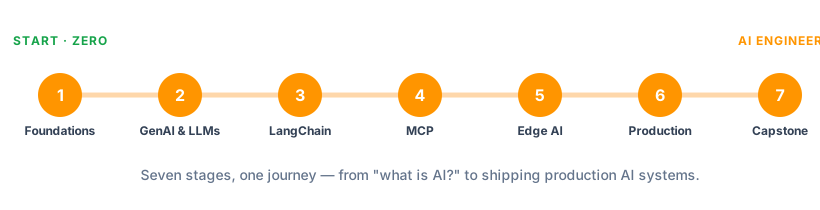
| Stage | Modules | You learned to… |
|---|---|---|
| 1. Foundations | 1–10 | Understand AI, ML, neural nets, CV, NLP, ethics |
| 2. Generative AI & LLMs | 11–14 | Explain and use LLMs, prompt well, stay safe |
| 3. LangChain | 15–22 | Build LLM apps: chains, tools, agents, RAG |
| 4. MCP | 23–30 | Connect AI to tools/data with a standard protocol |
| 5. Edge AI | 31–37 | Run optimized models on devices |
| 6. Production | 38–49 | Design, pipeline, serve, monitor, and cost-optimize |
| 7. Capstone & mastery | 50–53 | Tie it together in a real, shipped project |
Key idea: You don't need to master all seven before being useful. Even solid Foundations + one building skill (say, LangChain or MCP) plus a shipped project makes you employable. Depth comes with practice on real problems.
Think of the seven stages as a T-shape rather than a checklist. The horizontal bar is broad literacy — you can hold a sensible conversation about all seven areas, which is what Foundations plus a skim of the rest gives you. The vertical stroke is depth in one area you go deep on: maybe you become the person who really understands RAG systems, or edge deployment, or serving at scale. Employers hire the T: broad enough to collaborate across the whole loop, deep enough to own something real.
3. What to Build & Learn Next
- Finish your capstone (Module 51) and put it on GitHub.
- Go deeper where your target role needs it — LLM apps, MLOps, or edge.
- Enter Kaggle or contribute to open-source AI projects.
- Read papers & docs — you now have the vocabulary to follow them.
- Explore this platform's other tracks — ML for Beginners, Gen AI, AI Agents, and Data Science all reinforce these skills.
Real-world use case: A learner finishes this path, ships a RAG assistant capstone, writes it up on GitHub, and lands an "AI engineer" interview — where they confidently discuss LLMs, RAG, MCP, serving, and monitoring. The journey is the portfolio.
4. How to Keep Growing
- Build in public — ship small projects, share them
- Stay current — the field moves fast; follow docs and release notes
- Go deep, then broad — master the core loop before chasing every new tool
- Teach others — explaining a concept is the best way to cement it
A word on "staying current" without drowning: AI produces more headlines in a week than anyone can read. The skill is filtering. Anchor on the durable fundamentals you've learned here — they change slowly — and treat the flood of new models and tools as variations on concepts you already own, not as things to relearn from scratch. A new LLM is still next-token prediction; a new framework is still chains and tools. That grounding is exactly what this course gave you.
Common mistake: Endless "tutorial hell" — consuming courses without building. You've done the learning; now the growth comes from building real things and iterating. One shipped project teaches more than ten more tutorials.
✅ Checkpoint
- Name the seven stages of the path.
- What makes you employable even before mastering everything?
- What's the antidote to "tutorial hell"?
Answers: 1) Foundations, GenAI/LLMs, LangChain, MCP, Edge AI, Production, Capstone. 2) Solid foundations + one building skill + a shipped project. 3) Building real projects and iterating, not consuming more tutorials.
Key Takeaway: The path runs through seven stages — Foundations → GenAI/LLMs → LangChain → MCP → Edge AI → Production → Capstone. You needn't master all before being useful: foundations + one building skill + a shipped project is employable. Grow by building in public, going deep then broad, and escaping "tutorial hell" — the journey and its projects are your portfolio.
Further Learning
- Microsoft AI learning paths
- Kaggle Learn · Google ML Crash Course
- Source curricula: AI · Generative AI · MCP · Edge AI
Part of "Zero to AI Engineer." Adapted from Microsoft's open curricula (MIT License).