"Before machines learned from data, we tried to hand them our knowledge directly — as rules, facts, and logic."
Level: Beginner · Time: ~12 min · Prerequisites: Module 1
Learning Objectives
By the end of this module, you will be able to:
- Explain what symbolic ("good old-fashioned") AI is
- Describe knowledge representation and rules
- See the strengths and limits of the rules approach
- Understand why machine learning largely replaced it
1. Teaching by Rules, Not Examples
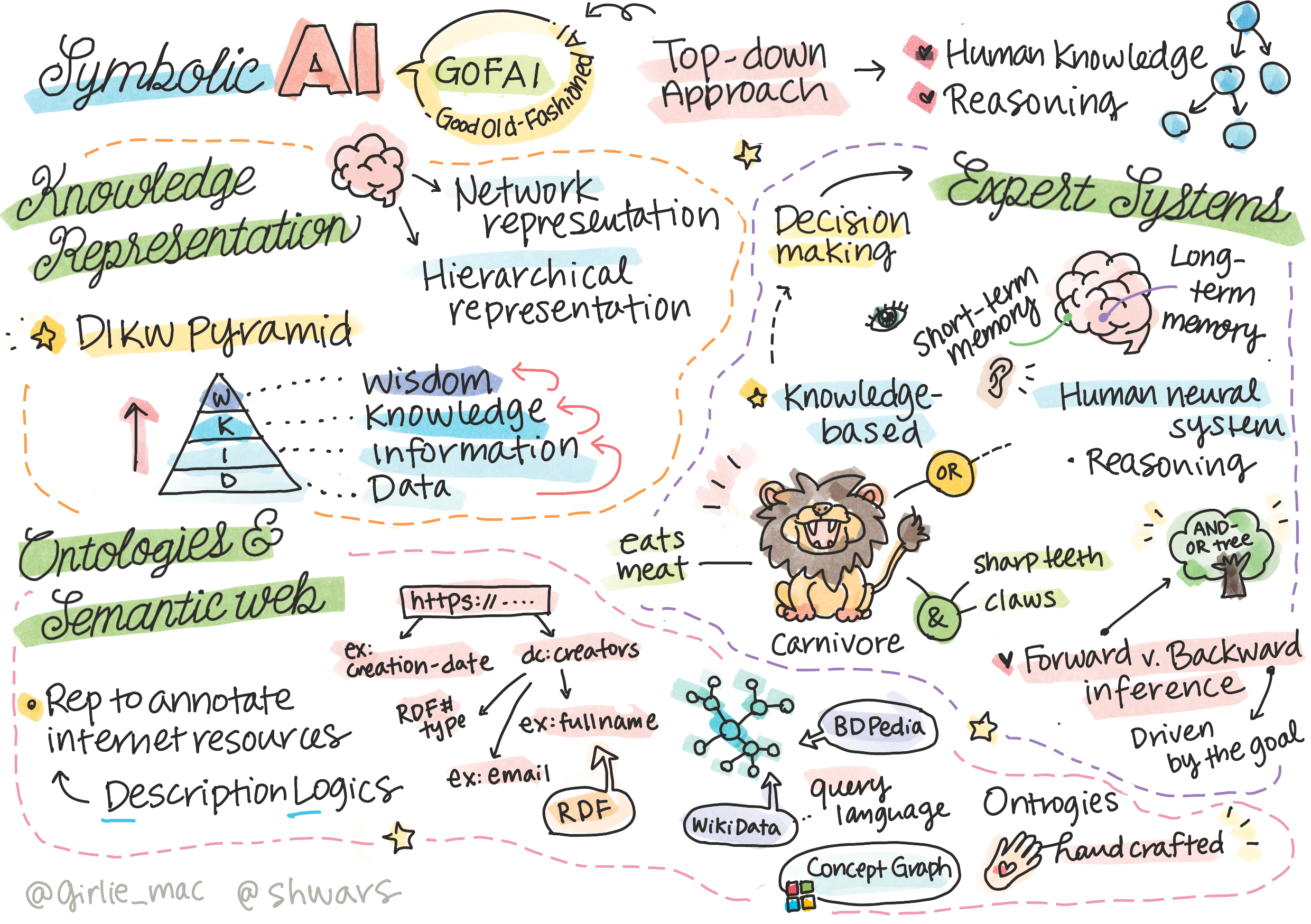
The earliest AI worked by encoding human knowledge explicitly. Experts wrote down facts and rules, and the computer used logic to draw conclusions. This is symbolic AI — sometimes called "good old-fashioned AI."
A rule looks like:
IF temperature > 38°C AND cough = yes THEN suggest = "see a doctor"
Chain thousands of such rules together and you get an expert system — software that mimics a human expert in a narrow field (early ones diagnosed diseases and configured computers). A famous example, MYCIN, was built in the 1970s to recommend antibiotics; it worked by asking a doctor a series of questions and firing rules to narrow down the likely infection. It often matched specialist advice — but only inside the tiny slice of medicine its rules covered.
Explain like I'm new: Symbolic AI is like giving someone an enormous, precise instruction manual. As long as a situation is in the manual, they respond perfectly. Face something the manual never mentioned, and they're stuck.
2. Knowledge Representation
For a computer to reason, knowledge must be stored in a structured form it can use:
- Facts: "A sparrow is a bird." "Birds have wings."
- Rules: "If X is a bird, then X can probably fly."
- Ontologies / knowledge graphs: networks of concepts and how they relate (Google's Knowledge Graph is a modern descendant).
The computer applies logic to combine facts and rules into new conclusions — "a sparrow probably flies" — without being told that directly. This chaining is called inference: start from what you know, apply rules, and derive what you didn't. A medical expert system might chain "patient has fever" + "fever with a rash suggests infection X" to propose a diagnosis nobody typed in explicitly.
Concept: Notice the word probably. Real reasoning is rarely black-and-white, so some systems attach a confidence number to each rule ("80% likely"). Those numbers still had to be guessed by experts, which hints at the deeper problem: the whole system is only as good as the humans filling it in.
Key idea: Symbolic AI separates knowledge (the facts and rules) from reasoning (the logic engine that applies them). Change the rules and the behavior changes — no retraining, just editing knowledge.
3. Strengths and Limits
| Strengths | Limits |
|---|---|
| Transparent — you can read every rule | Brittle — fails on cases not covered |
| No data needed — just expert knowledge | Hard to scale — real life needs millions of rules |
| Precise in clear domains | Can't handle fuzziness — images, speech, nuance |
| Explainable decisions | Expensive — experts must hand-write rules |
The fatal problem: the real world is messy and infinite. You can't write a rule for every way a cat might look in a photo. That's exactly where machine learning wins.
Real-world use case: Symbolic AI isn't dead — it powers tax software, business rule engines, and configuration tools, where rules are clear and explanations are legally required. Many modern systems are hybrid: ML perceives the messy world, symbolic rules enforce clear policies.
4. Why ML Took Over
As data and computing power exploded, learning patterns from examples proved far more practical than hand-writing rules for fuzzy tasks. A model shown millions of cat photos learns "cat-ness" no human could ever fully spell out in rules. Ask yourself: could you write down, in IF/THEN form, every rule that separates a cat from a small dog in a photo? Pointy ears? Dogs have those too. The task is hopeless for rules but easy for a model that has seen enough examples. The rest of this foundations section is about that learning approach.
Real-world use case: Today's most powerful setups are often neuro-symbolic — a neural network reads a messy invoice photo (perception), then a rules engine checks the extracted totals against accounting policy (logic). You get the flexibility of learning with the reliability and auditability of rules.
Hands-On: Try This
Try this: Write 3 rules for "is this email urgent?" (e.g., IF from = boss THEN urgent). Then think of an urgent email your rules would miss. Feeling that gap is exactly why the field moved toward learning from data.
Common Mistakes
Common mistake: Assuming rules and ML are enemies. The best real systems combine them — ML for perception and prediction, rules for guardrails, compliance, and clear business logic. Knowing when to use each is a senior skill.
✅ Checkpoint
- What are the two separate parts of a symbolic AI system?
- Give one strength and one weakness of the rules approach.
- Why did ML overtake symbolic AI for tasks like image recognition?
Answers: 1) Knowledge (facts/rules) and reasoning (logic engine). 2) Strength: transparent/explainable; weakness: brittle/can't scale to fuzzy tasks. 3) You can't hand-write rules for every possible image; ML learns the pattern from examples.
Key Takeaway: Symbolic AI encodes human knowledge as facts and rules and reasons over them with logic — transparent and precise, but brittle and unable to handle fuzzy, real-world inputs. Machine learning replaced it for perception tasks by learning patterns from data, though rules still shine (and combine with ML) where clarity and explainability matter.
Further Learning
Adapted from Microsoft's AI for Beginners (MIT License). Sketchnote by Tomomi Imura.