"A chatbot answers your question. An AI agent goes and gets the job done."
Learning Objectives
By the end of this module, you will be able to:
- Define an AI agent in one plain sentence
- Tell agents apart from chatbots and normal automation
- Recognize real-world agents
- Explain why agents are a big step beyond chat
1. A Simple Definition
An AI agent is software that uses a language model (an LLM) to pursue a goal — it can reason about what to do, use tools to take action, remember what happened, and keep going step by step until the task is done.
The magic word is goal. You don't tell an agent every click to make; you tell it what you want, and it figures out the steps. A chatbot waits for the next question. An agent takes initiative: it decides what to do next, does it, checks the result, and continues on its own until the goal is reached or it needs your help.
Explain like I'm new: Imagine hiring an assistant. A chatbot only answers what you ask — "How do I book a flight?" An agent hears "book me a flight to Chicago next Friday under $300" and actually does it: searches, compares, and books. Same conversation, very different result.
Key idea: A plain chatbot produces words. An agent produces outcomes. Give it a goal like "find three quotes for a new laptop and email me a summary," and it will search, compare, and send — not just describe how you could.
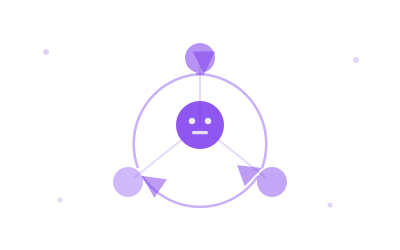
Three abilities make this possible, and the rest of this track keeps returning to them. An agent can reason (think through the next step), use tools (search, calculate, send, fetch — reaching outside its own text), and remember (carry information forward so later steps build on earlier ones). Reasoning without tools is just a chatbot; tools without reasoning is just automation. Combine all three, and you get an agent.
2. Agent vs. Chatbot vs. Automation
These three get mixed up constantly. Here's the clean distinction:
| What it does | Example | |
|---|---|---|
| Automation (scripts) | Follows fixed, pre-written rules | "Every Monday at 9am, back up the folder" |
| Chatbot | Answers and converses, one reply at a time | "What's your return policy?" |
| AI agent | Plans, decides, and acts over multiple steps to reach a goal | "Sort my inbox, draft replies, and flag anything urgent" |
Automation is rigid but reliable — it does exactly what it's told and breaks the moment reality differs from the script. Chatbots are flexible but only talk; they hold a smart conversation but can't lift a finger in the real world. Agents combine flexibility with action — they choose what to do and how, then do it, adapting when something unexpected shows up.
Common mistake: Assuming anything that "chats using AI" is an agent. The test isn't how well it talks — it's whether it can take actions toward a goal across multiple steps. If it only replies, it's a chatbot.
3. Real-World Examples
- Research assistant — searches multiple sources, reads them, and writes you a summary with links.
- Scheduling assistant — checks your calendar, finds a free slot, and books the meeting.
- Customer support agent — looks up an order, updates an address, and notifies the courier.
- Coding helper — reads an error, edits the file, runs the tests, and repeats until they pass.
Notice the pattern: each one takes real actions, not just gives advice. The coding helper is a great example — it doesn't just tell you why your test failed; it changes the code, reruns the test, and keeps looping until it passes or it's stuck.
Real-world use case: Ask a research agent, "Which laptop under $1,000 has the best battery life?" A chatbot lists models from memory — possibly out of date. An agent searches current reviews, compares the figures it actually reads, and answers with links to its sources. That round trip to the real world is the whole point.
4. Why AI Agents Matter
Agents matter because they close the gap between knowing and doing. A chatbot can tell you the steps to plan a trip; an agent can actually check flights, compare prices, and draft the itinerary. That shift — from advice to action — is why agents are one of the most important ideas in AI today. It also changes what a computer is for many people: instead of clicking through five apps, you describe the outcome and let the agent operate the tools.
Beginner tip: You don't need to build an agent to understand one. As you go through this track, keep asking: "What is the goal? What tools can it use? How does it know when it's done?" Those three questions unlock almost any agent.
Key Takeaway: An AI agent is an LLM that pursues a goal by reasoning, using tools, and acting step by step — unlike rigid automation or reply-only chatbots. Agents turn advice into action, which is exactly why they matter. Throughout this track, watch for the goal, the tools, and the stopping point.